Post-Breakage Performance of Laminated Glass: Residual Capacity, Failure Mechanisms, and Design
Why Post-Breakage Matters
When a glass ply in a laminated element breaks, whether from impact, thermal stress, nickel sulphide inclusion, or accidental overload, the structure does not cease to exist. The polymeric interlayer holds the fragments together, and the cracked laminate continues to carry load. How much load, and for how long, is the subject of post-breakage design.
Post-breakage performance is not a secondary consideration. For any application where glass is a structural element (balustrades, overhead glazing, floors, glass fins) it is a primary design requirement. A laminated glass balustrade that shatters and loses all load-carrying capacity is a life-safety failure, even if the glass fragments remain bonded to the interlayer.
The core question: After one or both glass plies break, can the laminated element still resist the design loads (or a reduced set of loads) for long enough to prevent injury and allow safe replacement? The answer depends on the glass type, the interlayer material, the temperature, the support conditions, and the fragment pattern.
The Three-Stage Failure Model
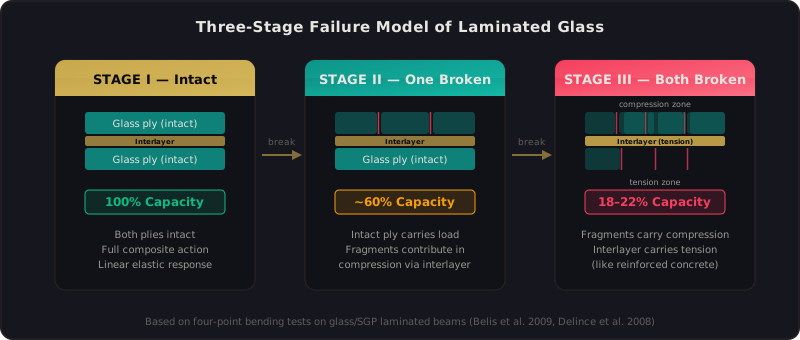
The post-breakage behaviour of laminated glass follows a well-established three-stage model, developed through extensive experimental campaigns on glass beams and plates:
Stage I: Intact
Both glass plies are intact. The load-deflection response is linear elastic. The interlayer provides shear coupling between the plies (partial to full composite action depending on its stiffness). This is the normal service state.
Stage II: One ply broken
One glass ply has cracked while the other remains intact. The intact ply carries the majority of the load. The broken ply still contributes through compressive stress transfer across the interlayer: the fragments are held in place and can resist compression even though they cannot carry tension across the cracks. Residual capacity is typically around 60% of Stage I.
Stage III: Both plies broken
Both glass plies are cracked. The upper (compression-side) fragments carry compression, while the interlayer bridges the tension zone. This is analogous to reinforced concrete, where the concrete carries compression and the steel reinforcement carries tension, except here the “reinforcement” is the interlayer, and it is far weaker and more temperature-sensitive than steel.
Critical for beams: In in-plane (beam) loading, fracture of one glass ply almost always triggers immediate fracture of the second ply at the same cross-section. Stage II is effectively skipped. Design should not rely on Stage II capacity for beam applications.
Residual capacity: what the numbers say
Experimental data from four-point bending tests on glass/SGP laminated beams provides a clear picture of residual capacity at each stage:
| Stage | Condition | Typical Residual Capacity | Dominant Mechanism |
|---|---|---|---|
| I | Both plies intact | 100% (reference) | Composite glass + interlayer |
| II | One ply broken | ~60% | Intact ply + fragment compression |
| III | Both plies broken | 18–22% | Fragment compression + interlayer tension |
For out-of-plane loaded plates, the post-breakage response follows a different pattern with three sub-stages: an initial nearly-linear phase, a hardening phase where bottom fragments begin detaching, and a ductility plateau with fluctuating load as yield-line patterns form, analogous to yield-line theory in reinforced concrete slabs.
Glass Type: The Single Biggest Factor
The choice of glass type has a greater influence on post-breakage performance than any other design parameter, including the interlayer material. The reason is simple: the fragment pattern determines how effectively the broken glass can interlock across the interlayer and continue to transfer load.
Annealed glass (ANG)
Produces large, sharp, irregular fragments that interlock effectively across the interlayer. These large fragments can still carry significant compressive and even some tensile forces through mechanical engagement. ANG in the tension layer of a laminated plate gives the best post-breakage capacity: up to 83% of the pre-breakage peak resistance in plate tests with ionomer interlayer.
Heat-strengthened glass (HSG)
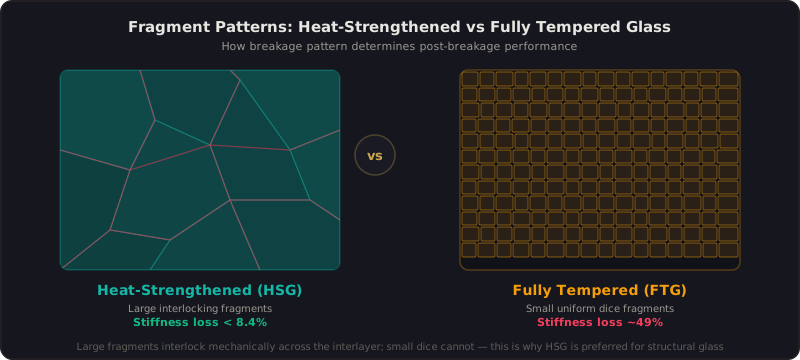
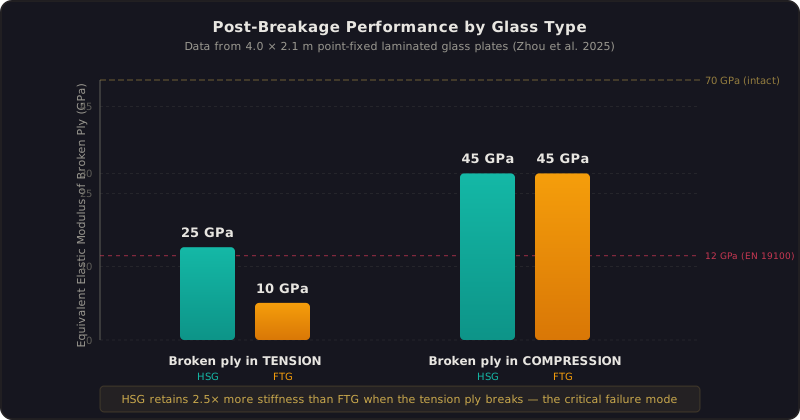
Produces moderately-sized fragments that maintain good interlocking. HSG offers the best balance between pre-breakage strength (approximately 70–114 MPa vs. 45–54 MPa for ANG) and post-breakage performance. Large-scale tests on 4.0 × 2.1 m point-fixed plates show that breaking the HSG tension ply reduces stiffness by less than 8.4%: the broken ply continues to contribute 3.9× more stiffness than a single intact ply alone.
Fully tempered glass (FTG)
Shatters into small dice-like fragments (as designed for safety under impact). These fragments provide poor interlocking because they are too small and too uniform to mechanically engage across the interlayer. In the same large-scale plate tests, breaking the FTG tension ply reduces stiffness by approximately 49%, and the broken ply contributes only 2.6× (vs. 3.9× for HSG) the stiffness of a single intact ply.
The HSG paradox: Fully tempered glass is stronger before it breaks but weaker after. Heat-strengthened glass is the preferred choice for all post-breakage-critical applications because it combines adequate pre-breakage strength with vastly superior post-breakage fragment interlocking. This is why every major code and design guide recommends HSG for structural laminated glass.
Quantitative comparison from large-scale plate tests
| Parameter | HSG Broken (tension) | FTG Broken (tension) |
|---|---|---|
| Stiffness reduction | < 8.4% | ~49% |
| Equivalent modulus of broken ply | 25 GPa (36% of intact) | 10 GPa (14% of intact) |
| Stiffness contribution factor | 3.9× single intact ply | 2.6× single intact ply |
When the broken ply is on the compression side rather than the tension side, both glass types perform much better: the equivalent modulus rises to approximately 45 GPa (64% of intact) regardless of glass type, because the fragments are in compression and do not need to interlock to transfer force.
Hybrid configurations
Placing annealed glass on the tension side and fully tempered glass on the compression side (FTG/interlayer/ANG) yields the best post-breakage performance: peak resistance of 19.1 kN vs. 12.8 kN for FTG/interlayer/FTG in 1 m × 1 m plate tests with ionomer interlayer. The trade-off is that ANG has lower pre-breakage strength, so the total design must balance both states.
The Role of the Interlayer
In the post-breakage state, the interlayer serves two functions: it holds the fragments in place (retention) and it carries tension across the cracks (bridging). The material properties that govern these functions are fundamentally different from those that govern pre-breakage shear coupling.
SGP/Ionomer vs. PVB: not always what you expect
| Property | PVB | SGP / Ionomer |
|---|---|---|
| Elastic modulus (MPa) | 2–18 | 300–480 |
| Tensile strength (MPa) | 20–30 | 33–36 |
| Elongation at failure (%) | 250–430 | 330–400 |
| Tg (°C) | 10–40 | 55–60 |
| Adhesion to glass | Moderate, controllable | Very high |
SGP is approximately 17–200× stiffer than PVB depending on temperature and load duration. In beam tests, SGP laminates consistently carry approximately 10 kN more than PVB laminates across all configurations. SGP also provides 9.8× greater resistance to lateral torsional buckling, which is critical for tall, slender glass beams.
The delamination paradox
One of the most counter-intuitive findings in the post-breakage literature is that higher adhesion does not always mean better post-breakage performance. SGP’s very high adhesion to glass prevents the local delamination that is needed for distributed stress transfer across a crack. Instead, strain concentrates at crack origins, causing premature tearing of the SGP interlayer.
PVB, with its lower adhesion, allows significant local delamination zones around each crack. This spreads the strain over a larger interlayer area, enabling large stretching before collapse. The result: in beam bending, PVB laminates can sometimes exhibit more ductile post-breakage behaviour than SGP laminates, even though SGP carries higher absolute loads.
Design implication: For beam applications where ductility and warning before collapse are critical, the adhesion characteristics of the interlayer deserve as much attention as its stiffness. For plate applications under out-of-plane loading, SGP generally outperforms PVB because the loading geometry is different and delamination is less critical.
Interlayer thickness matters
Increasing ionomer interlayer thickness from 3 mm to 5 mm increases post-breakage stiffness by approximately 120% in plate tests. This is a highly effective design lever, often more practical than changing glass type or adding plies.
Fragment Interlocking and Crack Patterns
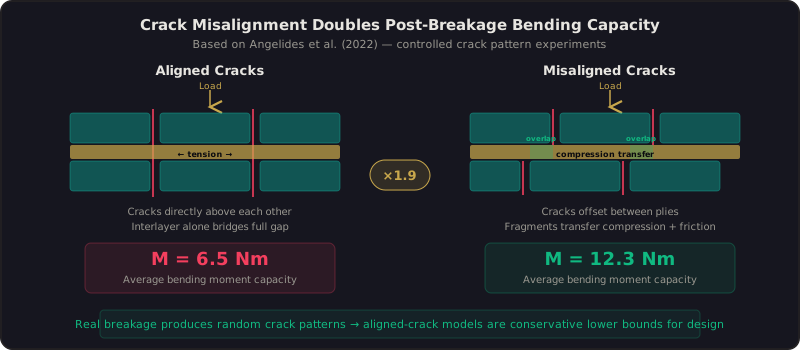
The residual capacity of broken laminated glass depends critically on how the fragments of the two glass plies align relative to each other. When cracks in the upper and lower plies are aligned (directly on top of each other), the interlayer must bridge the full gap in tension. When cracks are offset (misaligned), the overlapping fragments can transfer forces through compression and friction, dramatically increasing capacity.
Crack misalignment nearly doubles bending capacity
Controlled experiments comparing aligned vs. misaligned crack patterns in laminated glass beams found:
- Aligned cracks: Average bending moment capacity of 6.5 Nm
- Misaligned cracks (60 mm offset): Average bending moment capacity of 12.3 Nm
- Ratio: 1.89×, nearly double the capacity from crack misalignment alone
The reason is geometric: misaligned cracks require the formation of an additional crack in the “compression” glass layer before a plastic hinge can develop. This additional crack provides extra energy absorption and load-carrying capacity.
The fragment overlap rate
Research using modified through-crack tensile tests defines the fragment overlap rate as ζ = 2s/a, where s is the overlap length and a is the fragment size. This parameter ranges from 0 (fully aligned cracks) to 1 (maximum offset).
A key finding: the minimum stiffness occurs at ζ ≈ 0.1, not at ζ = 0 (fully aligned) as commonly assumed. Below ζ = 0.1, force flows almost entirely through interlayer tension. Above ζ = 0.15, force increasingly transfers through the glass fragments via compression and shear (tension stiffening), and stiffness increases rapidly.
The practical consequence: offset cracks in PVB laminates at room temperature provide up to 459% stiffness enhancement and 239% strength enhancement over aligned cracks. Even small amounts of crack misalignment are highly beneficial.
Why this is conservative for design: In real breakage events, cracks in the two glass plies are almost never perfectly aligned. Random fracture patterns produce a mix of aligned and misaligned regions. Analytical models that assume fully aligned cracks therefore provide a conservative lower bound for residual capacity, a useful property for design calculations.
Dynamic crack propagation
High-speed photography reveals that cracks in laminated glass propagate at approximately 810–1,150 m/s. The entire cracking event completes within roughly 100 microseconds. In a two-ply laminate under impact, the supported (backing) layer always cracks first from in-plane tensile stress waves, while the loaded layer cracks later via a distinct re-initiation mechanism. The inter-plate cracking delay depends on interlayer thickness: 330 μs for 0.76 mm PVB, increasing to 1,600 μs for 3.04 mm PVB. Despite the different timing, the final crack patterns on both layers end up essentially overlapping.
Temperature Effects
Temperature is the most important environmental factor for post-breakage performance because it directly controls interlayer stiffness. All polymer interlayers soften dramatically as temperature increases, and their glass transition temperature (Tg) marks the boundary between glassy (stiff) and rubbery (soft) behaviour.
Ionomer (SGP/SG) post-breakage capacity vs. temperature
Bending tests on pre-cracked SG-laminated beams at three temperatures:
| Temperature | Peak Post-Breakage Load | Relative to 23°C | Failure Mode |
|---|---|---|---|
| 23°C | 8,000–9,000 N | 100% | Interlayer tearing (small opening angle) |
| 45°C | 6,000–7,000 N | ~75% | Large delamination, no tearing |
| 60°C | 2,000–3,000 N | 25–35% | Interlayer tearing at much lower load |
The capacity reduction is severe: at 60°C, only 25–35% of room-temperature post-breakage capacity remains. Since Tg for SGP is approximately 55–60°C, this temperature range straddles the glass transition, explaining the dramatic loss.
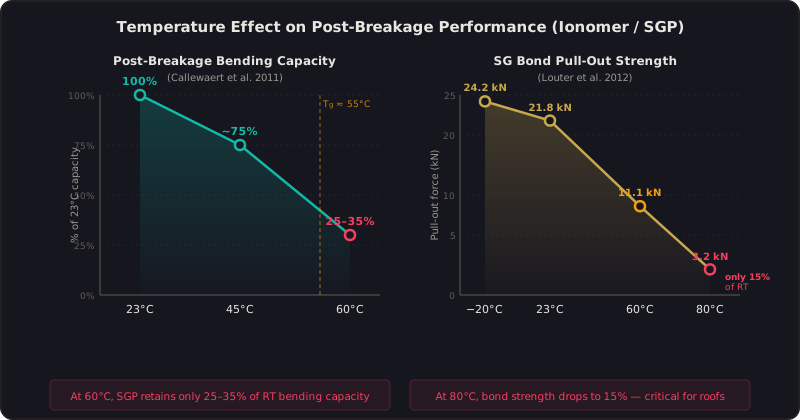
Bond strength temperature dependence
Pull-out tests on SG-bonded stainless steel reinforcement in glass show an approximately linear decline:
| Temperature | Pull-out Strength | Relative to 23°C |
|---|---|---|
| −20°C | 24.2 kN | 111% |
| 23°C | 21.8 kN | 100% |
| 60°C | 11.1 kN | 51% |
| 80°C | 3.2 kN | 15% |
The rate is approximately −0.21 kN per °C. At 80°C, only 15% of room-temperature bond strength remains, a critical consideration for overhead glazing and roof applications exposed to solar heating.
PVB adhesion at elevated temperature and humidity
PVB adhesion is even more temperature-sensitive than SGP due to its lower Tg (10–40°C). At 50°C and 80% relative humidity, PVB through-thickness adhesion drops to approximately 20% of room-temperature values. Creep-to-failure tests show that PVB delaminates at only 13–15% of its quasi-static strength at 50°C/80% RH under sustained loading, compared to 17–23% at room temperature.
Fragment interlocking and temperature
Temperature also affects the tension stiffening benefit from fragment overlap. For PVB laminates, the stiffness enhancement from offset cracks drops from 459% at 20°C to 168% at 80°C. For SGP laminates, the effect is even more dramatic: stiffness enhancement from fragment overlap drops from 52% at 20°C to only 9% at 80°C, though strength enhancement remains significant (273%). Above Tg, the interlayer becomes too soft to effectively transfer compression through fragment contact zones.
Application-Specific Guidance
Glass beams and fins
Glass beams loaded in-plane are the most demanding application for post-breakage design because Stage II is effectively non-existent (both plies fracture simultaneously) and the interlayer must carry all tension.
- SGP beams carry approximately 10 kN more than PVB beams across all tested configurations
- SGP provides 9.8× greater lateral torsional buckling resistance than PVB; lateral restraint (X-bracing) is essential for PVB beams but may not be required for SGP beams
- After complete failure of tempered plies, SGP beams still carry a residual ~2 kN; PVB beams carry almost nothing
- Reinforced glass beams (stainless steel bar bonded with SG) can achieve post-breakage loads of 150–167% of the initial glass breakage load at room temperature
- Such reinforced beams sustained 80% of their ultimate load for 3 to 22 months in the cracked state, demonstrating true long-term post-breakage capacity
Plates under out-of-plane loading
Post-breakage stiffness of laminated glass plates is less than 5% of pre-breakage stiffness in all tested configurations. Design must accommodate very large deflections in the broken state.
| Configuration (1 m × 1 m plates) | Initial Stiffness (N/mm) | Peak Resistance (kN) |
|---|---|---|
| FTG/SG 3mm/ANG (simple support) | 175 | 19.1 |
| ANG/SG 3mm/FTG (simple support) | 119 | 15.0 |
| FTG/SG 3mm/FTG (simple support) | 42.3 | 12.8 |
| FTG/SG 5mm/FTG (simple support) | 93.7 | 14.1 |
| FTG/SG 3mm/FTG (bolted) | 42.3 | 10.2 |
| Tri-layer all SG | 364 | 40.4 |
| Tri-layer SG/PVB hybrid | — | 15.2 |
Key findings: placing ANG on the tension side gives the highest capacity (19.1 kN); increasing SG thickness from 3 to 5 mm more than doubles initial stiffness (42.3 → 93.7 N/mm); simple supports provide approximately 4× higher stiffness than bolted point fixings.
Overhead glazing and canopies
Overhead applications are the most safety-critical because falling glass fragments pose a direct life-safety hazard. Large-scale tests on 4.0 × 2.1 m point-fixed canopy plates reveal severe consequences:
- 4-point fixed plates with a broken bottom ply are near collapse under self-weight alone, with effectively zero safety margin
- 6-point fixing provides approximately 4× the stiffness of 4-point fixing (1,117 vs. 290 N/mm), dramatically improving the post-breakage safety margin
- Heat-strengthened glass is essential: HSG tension-side breakage causes < 8.4% stiffness loss vs. ~49% for FTG
Design rule for overhead glass: Always use heat-strengthened glass, maximise the number of support points, and verify that the broken laminate can sustain self-weight plus a reduced service load at the maximum expected temperature. A 4-point fixed canopy with FTG glass may have zero post-breakage capacity. This is an unacceptable design for overhead applications.
Curved (cold-bent and warm-bent) glass
When a ply breaks in curved laminated glass, the stored elastic bending energy is released as spring-back. The concave ply dominates this response, accounting for 70–80% of the total spring-back. Fully tempered glass loses approximately 89–91% of its imposed curvature after breakage (nearly completely flat), while heat-strengthened glass with 8 mm thickness shows less than 10% spring-back. For warm-bent structural glass, time-delayed crack propagation has been observed: cracks continue appearing minutes after the initial breakage event.
Durability and Environmental Effects
Humidity degrades interlayer bonds
Moisture exposure is the greatest long-term threat to post-breakage capacity. SG-bonded connections exposed to 4 weeks at 50°C/100% RH lose 45% of their pull-out strength (21.8 kN → 12.1 kN), with visible white hazing and local delamination at the bond perimeter. In severe cases, beam specimens have partly disintegrated during testing after humidity exposure. Edge sealing and moisture-resistant detailing are critical for any SG-bonded assembly.
Thermal cycling
150 cycles between −20°C and +30°C reduced pull-out strength to only 29% of room-temperature values (6.2 kN vs. 21.8 kN), with some specimens showing spontaneous delamination during cycling. However, at the beam scale, thermal cycling had almost no measurable effect on overall structural response, suggesting that the bond degradation is localised to the edges and does not propagate to the full cross-section under typical service conditions.
Creep under sustained loading
Post-breakage capacity under sustained (permanent) loading is governed by creep. A power-law creep-to-rupture model for PVB adhesion gives the time to failure as tf = a · LL−m, where LL is the sustained load as a percentage of quasi-static strength. At room temperature, the 95th-percentile failure time at 22.5% load level is 10 hours; at 50°C/80% RH, failure at only 13.3% load level occurs within 10 hours. Post-breakage designs relying on sustained loading must account for this progressive degradation.
Manufacturing quality
Glass planarity defects (roller waves from the tempering process) create permanent through-thickness tensile stress on the interlayer even before any breakage event. “Unfavourable” glass orientations can produce gaps of 0.35–0.40 mm between glass plies vs. 0.05–0.10 mm for “favourable” orientations. These pre-existing stresses can initiate delamination over time, compromising the interlayer’s ability to retain fragments after breakage. This issue is not currently regulated in standards.
Standards Framework: PFLS in CEN/TS 19100
CEN/TS 19100 (the future Eurocode 10) introduces the Post-Fracture Limit State (PFLS) as a formal design verification alongside the classical Ultimate Limit State (ULS) and Serviceability Limit State (SLS). This is the first time a European structural design code explicitly requires post-breakage verification for glass.
What PFLS requires
- The laminated glass element must demonstrate residual strength and stiffness for a specified period after breakage of one or more plies
- The verification can be performed by testing (pendulum impact, static loading of pre-cracked specimens) or by calculation using reduced material properties
- CEN/TS 19100 suggests using a reduced elastic modulus for the broken ply in simplified calculations
Reduced modulus values
CEN/TS 19100 suggests an equivalent elastic modulus of 12 GPa for broken heat-strengthened glass laminated with ionomer. Recent large-scale experimental validation shows this value is conservative for HSG (measured: 25 GPa) but adequate or slightly optimistic for FTG in tension (measured: 10 GPa). For broken plies in compression, 45 GPa is a more appropriate value regardless of glass type.
| Broken Ply Condition | CEN/TS 19100 | Experimental (Large-Scale) |
|---|---|---|
| HSG, tension side | 12 GPa | 25 GPa (conservative by 2×) |
| FTG, tension side | 12 GPa | 10 GPa (slightly unconservative) |
| Any type, compression side | — | 45 GPa |
Three analysis levels
CEN/TS 19100 defines three modelling levels for laminated glass, all applicable to PFLS:
- Level 1: No coupling (layered) or full coupling (monolithic): simplest, most conservative
- Level 2: Enhanced effective thickness method with interlayer shear modulus at the relevant (time, temperature) pair
- Level 3: Full numerical analysis (FEM) with viscoelastic interlayer model: most accurate, required for complex geometries and post-breakage verification of critical elements
Design Recommendations
| Parameter | Recommendation |
|---|---|
| Glass type | Heat-strengthened glass for all post-breakage-critical applications. ANG on tension side if post-breakage capacity is the governing criterion. |
| Interlayer for plates | Ionomer (SGP/SG): superior stiffness and fragment retention under out-of-plane loading. |
| Interlayer for beams | Ionomer provides highest absolute capacity, but consider the delamination paradox: verify ductility is adequate for the application. |
| Interlayer thickness | Maximise where practical; doubling SG thickness from 3 to 5 mm yields ~120% stiffness increase. |
| Temperature | Verify post-breakage capacity at the maximum expected service temperature. SG capacity drops to 25–35% at 60°C. |
| Support points | Maximise the number of support points for overhead applications. 6-point fixing provides ~4× the stiffness of 4-point fixing. |
| Edge protection | Seal all edges against moisture. SG bond strength drops 45% under humidity exposure; PVB adhesion drops to ~20% at 50°C/80% RH. |
| Analytical approach | Aligned-crack models are conservative lower bounds. Use EN 19100 reduced modulus values with caution: 12 GPa is conservative for HSG but may be unconservative for FTG. |
| Reinforcement | For glass beams requiring sustained post-breakage capacity, consider stainless steel reinforcement bonded with SG, which achieves 150–167% of initial breakage load. |
| Avoid | Never use monolithic FTG for structural applications requiring post-breakage capacity. Avoid 4-point fixing for overhead glazing. Do not assume constant interlayer properties across seasons. |
Verify Your Post-Breakage Design
Use our free tools to compute interlayer shear modulus at any temperature and load duration: the key inputs for post-breakage verification per CEN/TS 19100.
Launch Simulation ToolsReferences
- Delince, D. & Belis, J. (2008). “Post-breakage behaviour of laminated glass in structural applications.” Proceedings ISAAG, Munich.
- Angelides, S.C., Talbot, J.P. & Overend, M. (2022). “The influence of fracture pattern on the residual resistance of laminated glass at high strain-rates.” Glass Structures & Engineering, 7, 67–86.
- Biolzi, L., Cattaneo, S. & Rosati, G. (2010). “Progressive damage and fracture of laminated glass beams.” Construction and Building Materials, 24(4), 577–584.
- Xie, D. et al. (2024). “Mechanical Enhancement of Fractured Laminated Glass considering Fragment Overlaps and Temperatures.” Challenging Glass Conference Proceedings, 9.
- Bao, M., Yin, K. & Li, W. (2024). “Experimental Investigation of Post Failure Performance of Warm Bent Laminated Glass.” Challenging Glass Conference Proceedings, 9.
- Mueller, J. et al. (2024). “Imperfections in Laminated Safety Glass: An Experimental Case Study on Through-Thickness Tensile Adhesion.” Challenging Glass Conference Proceedings, 9.
- Belis, J. et al. (2008). “Analytical model for the post-breakage response of laminated glass.” Proceedings of ISAAG.
- Belis, J., Depauw, J., Callewaert, D., Delince, D. & Van Impe, R. (2009). “Failure mechanisms and residual capacity of annealed glass/SGP laminated beams at room temperature.” Engineering Failure Analysis, 16(6), 1866–1875.
- Louter, C., Belis, J., Veer, F. & Lebet, J.-P. (2012). “Durability of SG-laminated reinforced glass beams: effects of temperature, thermal cycling, humidity and load-duration.” Construction and Building Materials, 27(1), 280–292.
- Callewaert, D. et al. (2011). “Influence of temperature on the post-breakage bridging behaviour of laminated glass.” Glass Performance Days (GPD), Tampere.
- Chen, J. et al. (2014). “An experimental investigation of the dynamic failure of PVB laminated glass under impact.” Journal of the European Ceramic Society, 34(15), 3647–3656.
- Davydova, M. & Davydov, D. (2007). “Fractal analysis of fragmentation patterns of glass plates.” International Journal of Modern Physics B, 22(9–11), 1375–1380.
- Zhao, C. et al. (2019). “Post-breakage behavior of pre-cracked laminated glass plates with ionomer interlayer.” Construction and Building Materials, 224, 996–1006.
- Zhu, X. et al. (2010). “Experimental investigation of the dynamic crack propagation in PVB laminated glass.” Applied Mechanics and Materials, 29–32, 56–61.
- Zemanova, A., Zeman, J., Janda, T. & Sejnoha, M. (2020). “On pre- and post-fracture behaviour of laminated glass under bending.” Int. J. of Comp. Methods and Exp. Measurements, 8(4), 373–386.
- Zhou, W., Simoncelli, M., Biolzi, L. & Cattaneo, S. (2025). “Post-failure response of point-fixed laminated glass.” Engineering Structures (preprint, SSRN 6282901).
- Delince, D., Callewaert, D., Vanlaere, W., Belis, J. & Depauw, J. (2008). “Post-breakage behaviour of laminated glass in structural applications — Experimental validation.” Proceedings of Challenging Glass.
- Kott, A. & Vogel, T. (2004). “Safety of Laminated Glass Structures after Initial Failure.” Structural Engineering International (IABSE), 14(2), 134–138.