BIPV Laminated Glass: Structural Design for Facades and Roofs
Why BIPV Is Structurally Different
Building-Integrated Photovoltaics (BIPV) represents a paradigm shift in facade and envelope engineering: the glass elements that have traditionally served as passive weather barriers, structural membranes and daylighting components are now required to simultaneously generate electricity. This dual-function mandate introduces structural, thermal, durability and regulatory challenges that do not arise in conventional glazing or in standard ground-mounted PV arrays.
From a structural glass perspective, the critical differences are:
- Thinner glass plies (often 2–3 mm) compared to conventional architectural glazing, requiring large-deflection analysis.
- Non-standard interlayer stacks with EVA or POE encapsulants embedding silicon cells, altering the composite behaviour of the laminate.
- Higher solar absorptance driving thermal stresses that can exceed 36 MPa at glass edges under worst-case conditions.
- Regulatory ambiguity: the laminate often does not qualify as “laminated safety glass” under building codes, only as “laminated glass.”
Module Typologies and Glass Build-ups
PV cell technologies
Two main families of solar cell technology are used in BIPV applications:
- Thin-film modules (amorphous silicon, CIGS, CdTe, or organic cells): very thin, possible for flexible modules, but with lower efficiency than crystalline types.
- Mono- and polycrystalline modules: higher efficiency, available in translucent, coloured, metal-look or patterned variants. First pilot projects with transparent PV windows already exist. The market is developing extremely fast.
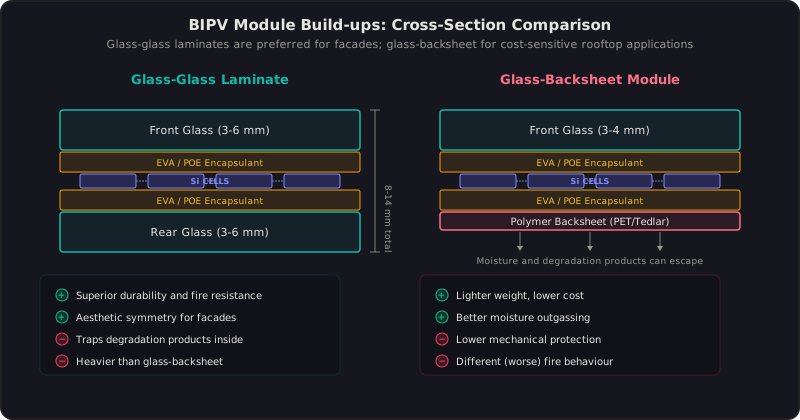
Glass-glass vs. glass-backsheet
BIPV laminates fall into two principal build-up categories:
- Glass-glass laminates sandwich the cells and encapsulant between two glass panes. Preferred for BIPV facades because they offer superior durability, fire resistance and aesthetic symmetry. However, they trap low-molar-mass degradation products that cannot easily diffuse out.
- Glass-backsheet modules use a polymer rear sheet (typically PET-based). The backsheet allows moisture and degradation products to escape more easily but offers lower mechanical protection and different fire behaviour.
Practical build-ups
The table below summarises common configurations found in BIPV projects:
| Type | Build-up |
|---|---|
| Thin-film glass-glass | Two thin float glass panes (often drilled) + encapsulant + thin-film cells |
| Crystalline glass-foil | Front glass + EVA/POE + crystalline Si cells + EVA/POE + polymer backsheet |
| Crystalline glass-glass | Front glass + encapsulant + crystalline Si cells + encapsulant + rear glass |
For insulating glass units (IGU) incorporating BIPV, a typical example is:
IGU with BIPV (example): Outer lite: LG 2×6 mm FTG with PV — Cavity: 16 mm — Middle pane: 4 mm — Cavity: 16 mm — Inner lite: LSG 2×6 mm HSG.
The Classification Challenge
One of the most important issues for structural engineers is that BIPV glass often cannot be classified in the traditional sense. Due to the very thin glass (often only 2–3 mm), it is frequently not possible to classify the panes as toughened safety glass or heat-strengthened safety glass. The glass is “something in between,” requiring dedicated four-point bending tests to establish its actual bending tensile strength.
Key regulatory distinction: Because the PV interlayer stack (EVA + silicon cells + interconnects) differs from standard PVB or ionoplast configurations, the laminate often does not qualify as “laminated safety glass” (LSG) under building codes but only as “laminated glass” (LG). This distinction has significant consequences for overhead and barrier applications where LSG is mandatory.
Thermal Stress in BIPV Modules
The fundamental mechanism
When solar radiation heats the exposed central region of a glazing pane while the edges remain cooler due to frame shading, the resulting temperature differential induces tensile stresses at the glass edges. If these stresses exceed the characteristic edge strength, thermal breakage occurs.
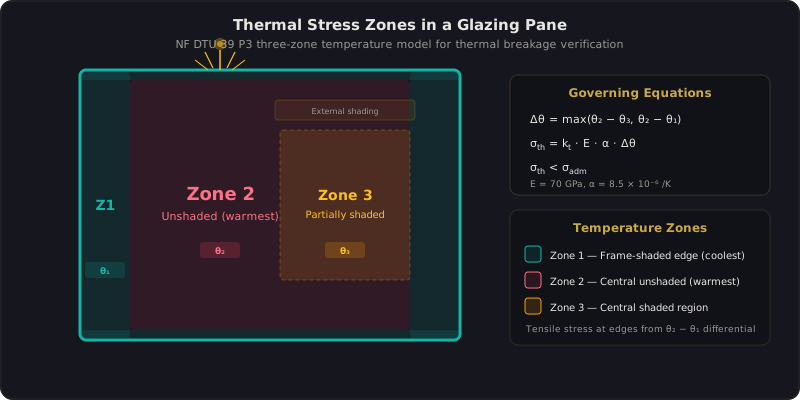
The NF DTU 39 P3 approach divides each pane into three temperature zones:
- Zone 1: frame-shaded region (edge) — coolest
- Zone 2: central unshaded region — warmest
- Zone 3: centrally shaded region (e.g., from partial external shading)
The governing temperature difference and thermally induced stress are:
Δθ = max(θ2 − θ3, θ2 − θ1)
σth = kt · E · α · Δθ
Where kt is the stress concentration factor, E is the Young’s modulus of glass (~70 GPa), and α is the thermal expansion coefficient (~8.5 × 10⁻⁶ /K).
Verification requires that the thermally induced stress remains below the allowable thermal stress:
σadm = kv · ka · σvm
σth < σadm
BIPV-specific complications
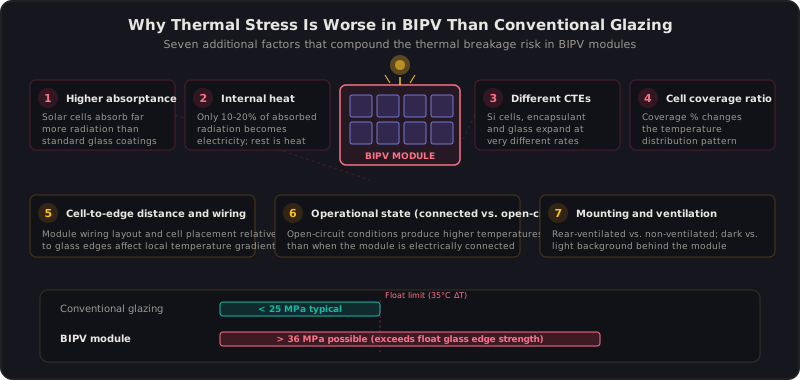
For BIPV modules, the thermal stress problem is compounded by several factors that do not arise in conventional glazing:
- Higher absorptance of solar cells compared to standard glass coatings.
- Internal heat generation: only 10–20% of absorbed radiation is converted to electricity; the rest becomes heat.
- Different thermal expansion coefficients of Si cells, encapsulant and glass.
- Cell coverage ratio influence on temperature distribution.
- Cell-to-edge distance and module wiring effects.
- Operational state: open-circuit conditions produce higher temperatures than electrically connected modules.
- Mounting system: rear-ventilated vs. non-ventilated; dark vs. light background behind the module.
Critical finding (Fraunhofer ISE, 2023): Thermal stresses can exceed 36 MPa at glass edges under worst-case meteorological conditions, surpassing the characteristic edge strength of float glass. A normatively regulated verification procedure is essential for BIPV.
Allowable thermal differences
| Glass type | Edges as-cut / arrissed | Smooth ground | Polished |
|---|---|---|---|
| Float (< 12 mm) | 35°C | 40°C | 45°C |
| Heat strengthened | 100°C | 100°C | 100°C |
| Tempered | 200°C | 200°C | 200°C |
Limitations of existing calculation methods
The French norm NF DTU 39 P3 is the only widely used European thermal stress calculation method but has significant limitations:
- Meteorological data applicable only to France (95 regions) and more than 60 years old.
- Outdated frame Uf values (5.5–7.0 W/m²K) vs. modern values below 1.0 W/m²K for passive houses.
- Does not adequately address BIPV modules.
The John-Colvin (Pilkington) method is a simplified British approach using average solar radiation with no seasonal or orientation dependency. It was developed for single and double glazing only, is considered overly conservative, and is not applicable to triple-IGUs or BIPV modules.
The Fraunhofer ISE project has developed and validated 1D simplified hand-calculation, 2D FE parametric, and 3D FE parametric methods, culminating in a draft European standard proposal for thermal stress verification in both conventional glazing and BIPV modules.
Meteorological Data Requirements
A critical insight from the Fraunhofer ISE study is that Typical Meteorological Years (TMYs) are unsuitable for thermal breakage assessment because they represent average conditions, not the extreme combinations of high solar irradiance and low ambient temperature that drive thermal breakage.
Critical combination: high solar irradiance + low ambient temperature (typically morning sun on a cold day, or a cold transition day with sudden intense sunshine).
The Fraunhofer project developed dedicated radiation-outdoor-temperature maps for Germany covering all facade orientations (8 azimuths: N, NE, E, SE, S, SW, W, NW) using DWD data with 10-minute temporal resolution, combined with a clearsky radiation model for low atmospheric turbidity conditions (worst case for thermal stress). Height corrections are also needed for both solar irradiance (increases with altitude) and outdoor temperature (decreases at ~0.65 K per 100 m).
Equivalent extreme-value radiation/temperature maps for the rest of Europe do not yet exist, representing a major knowledge gap.
Flexural Performance with Embedded Cells
Large-format panels
Large-format BIPV panels for facade applications can exceed 2 m² in area. The interaction between thin glass layers (typically 3–4 mm each), the encapsulant and the embedded solar cells under wind loading requires careful analysis. The importance of large-deflection theory for thin glass panes is well-established, together with the assessment of effective composite stiffness considering the encapsulant shear transfer.
Effect of embedded cells on stiffness
Research on BIPV laminated glass flexural behaviour has shown that:
- The embedded solar cells and their interconnects create discontinuities in the interlayer that affect the composite action between the glass plies.
- The effective shear transfer through the encapsulant is modified by the cell layout, leading to non-uniform stress distributions different from standard laminated glass theory predictions.
- Four-point bending tests and FE models confirm that BIPV laminates exhibit lower effective stiffness than equivalent glass-only laminates of the same total thickness.
- The presence of cells introduces local stress concentrations, particularly at cell edges and at the transition between cell-covered and cell-free regions.
Design implication: Standard laminated glass effective-thickness methods (e.g., EN 16612) may overestimate the structural performance of BIPV laminates. Project-specific FE analysis or experimental validation through four-point bending tests is recommended for critical applications.
Support Systems and Structural Analysis
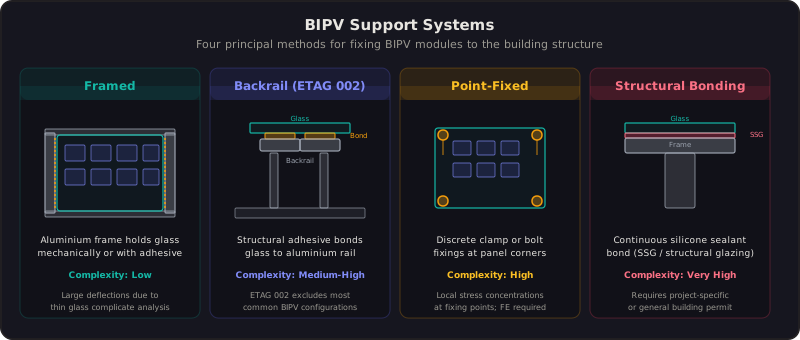
Framed modules
Seemingly simple to calculate, but complicated by large deflections due to thin glass and the fact that the frame is often glued to the glass (not just mechanically held).
Backrail systems (ETAG 002 / EAD 090010-00-0404)
One of the few normative regulations for structural bonding in the facade industry. However, the boundary conditions are restrictive:
- Aluminium or stainless steel bonding partner, 4-sided or 2-sided linear bonding.
- Adhesive joint width 6–20 mm, minimum thickness 4 mm.
- Maximum substructure deflection L/300, maximum pane deflection b/100.
- Global method factor of 6.0.
- Local effects and multidimensional stress states are not taken into account.
These restrictions exclude the most common BIPV applications, especially those with backrails that fall outside the standard bonding geometries.
True-stress FE approach
An alternative to the engineering-stress approach of ETAG 002 is to use FE analysis to identify the true safety factor and local stress peaks. This allows transfer of ETAG 002 design rules to alternative sealant dimensions and variable bonding layouts through a step-by-step verification and validation procedure (4 steps from material model to full-scale building element).
Substructure design
The substructure and connections are often designed to minimum cost using unregulated fasteners, rivets or clamp connections, making mathematical verification more difficult. This is a frequent weak point in BIPV installation design that requires careful engineering attention.
Design Reference: Material Properties
The table below provides room-temperature material properties for the main components of a BIPV module.
| Property | Glass | EVA | PVB | Silicon | Aluminium |
|---|---|---|---|---|---|
| Young’s modulus (GPa) | 70 | 0.013 | 0.0019 | 166 | 70 |
| Thermal conductivity (W/m·K) | 1.38 | 0.32 | 0.20 | 140 | 237 |
| Specific heat (J/kg·K) | 715 | 1600 | 1600 | 720 | 900 |
| CTE (1/K) | 8.5×10⁻⁶ | 1.6×10⁻⁴ | 2.2×10⁻⁴ | 2.62×10⁻⁶ | 2.5×10⁻⁶ |
| Density (kg/m³) | 2500 | 960 | 1000 | 2330 | 2700 |
Temperature dependence: Under fire or extreme thermal exposure, material properties change dramatically. Glass Young’s modulus remains ~70 GPa up to ~550°C then drops sharply. EVA modulus drops from ~0.013 GPa at room temperature to below 10−4 GPa above 80°C. Temperature-dependent properties are essential for accurate fire and extreme thermal analysis.
Allowable thermal stresses
| Glass type | Edges as-cut / arrissed | Smooth ground | Polished |
|---|---|---|---|
| Float (< 12 mm) | 20.3 MPa | 23.2 MPa | 26.2 MPa |
| Heat strengthened | 58.1 MPa | 58.1 MPa | 58.1 MPa |
| Tempered | 116.2 MPa | 116.2 MPa | 116.2 MPa |
Case Studies
Solar roof — private house in Munich (2011)
A rehabilitation project replacing conventional tiles with solar panels fixed directly to a wooden substructure with special clamps (no roof ties). Panels overlapped like tiles in a single-layer covering with ventilation behind. After 12 years of service, all glass-glass modules remain intact, efficiency unchanged, and insulation shows no signs of degradation.
Overhead glazing — ecological education centre
A glass roof in a mullion-transom construction that had suffered from insufficient slope, inner sealing defects and water penetration damage. Refurbishment integrated PV into multi-pane insulating glazing, replacing the outer monolithic toughened pane with a laminated safety glass of toughened safety glass embedding PV cells.
| Layer | Without PV | With PV |
|---|---|---|
| Outside | 8 mm FTG | LG 2×6 mm FTG with PV |
| Cavity | 16 mm | 16 mm |
| Middle | 4 mm | 4 mm |
| Cavity | 16 mm | 16 mm |
| Inside | LSG 2×6 mm HSG | LSG 2×6 mm HSG |
Facade — DHL parking garage, Leipzig-Halle Airport
Frameless PV modules on the south facade with fire protection requirements dictating large vertical gaps for ventilation. Modules at different inclinations created an architecturally desired wave appearance. The general type approval did not cover all shortened modules, so a project-specific type approval was obtained based on expert opinion.
Open Knowledge Gaps
Despite recent progress, significant gaps remain for the structural design of BIPV laminated glass:
| Domain | Gap | Priority |
|---|---|---|
| Thermal breakage | No unified European calculation standard for BIPV; NF DTU 39 P3 is outdated and France-only | High |
| Meteorological data | Extreme-value radiation/temperature maps needed for all European locations (only Germany covered) | High |
| Structural design | No harmonised verification method for thin-glass BIPV laminates across all support conditions | High |
| Fire performance | No validated fire-performance indicators specific to glass-glass BIPV; EN 1363-1 limits inadequate | High |
| Encapsulant durability | Optimal curing window characterised for EVA but not yet for POE, silicone or ionoplast in BIPV | Medium |
| Software tools | No commercially available validated software for thermal stress calculation in BIPV modules | Medium |
Model Your BIPV Project
Use FRACTAN’s engineering tools to assess interlayer behaviour and thermal stress for your BIPV laminated glass design.
Launch Dashboard