AI and Machine Learning for Structural Glass Engineering
Why AI for Structural Glass?
Structural glass design combines geometrically non-linear mechanics, time-dependent interlayer behaviour, and strict safety requirements into workflows that are computationally expensive and expertise-intensive. A single laminated glass verification under non-linear conditions can take minutes to hours in FEA, and real facade projects require hundreds of such evaluations across load cases, glass types, and interlayer stiffness values.
Machine learning offers a fundamentally different approach: train a model on large datasets of pre-computed FEA results, then use it to predict stresses and deflections in milliseconds. The construction industry has the lowest rate of digitisation of any major sector (McKinsey, 2017), but structural glass and facade engineering are described as “relatively progressive, innovative and open to technology” (Kraus & Drass, 2020) — making this field a natural early adopter.
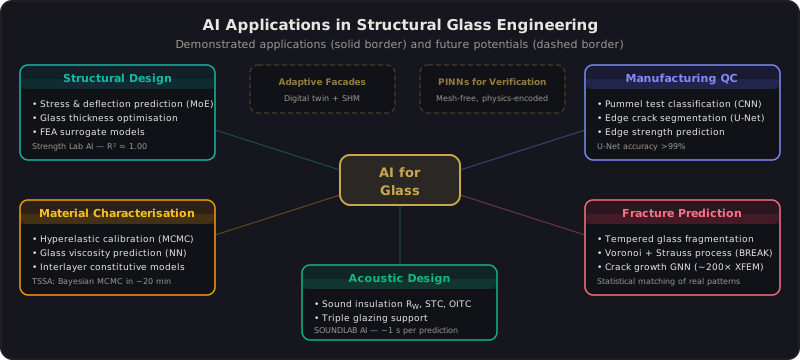
The applications already demonstrated go well beyond structural surrogates:
- Design: predicting stresses, deflections, and minimum glass thicknesses from parametric inputs.
- Manufacturing: automated quality control of laminated glass adhesion and cut edge quality.
- Material science: calibrating hyperelastic and viscoelastic constitutive models from experimental data.
- Acoustics: predicting sound insulation of glazing systems in seconds.
- Fracture: reconstructing and predicting tempered glass fragmentation patterns.
ML Methods at a Glance
The AI/ML landscape used in glass engineering follows a three-level hierarchy: AI encompasses ML, which encompasses Deep Learning (DL). The formal definition (Mitchell, 1997) states that a program learns from experience E for a task T under a performance measure P if its performance improves with experience.
The table below summarises the architectures that have been applied to glass-specific problems:
| Architecture | Type | Glass application |
|---|---|---|
| Feedforward NN (FNN) | Shallow / Deep | Glass thickness prediction, structural surrogates |
| Mixture-of-Experts (MoE) | Deep Learning | Strength Lab AI — stress and deflection prediction |
| Convolutional NN (CNN) | Deep Learning | Pummel test classification, glass edge segmentation |
| U-Net | Encoder-decoder CNN | Semantic segmentation of cut glass edges |
| Extra Trees Regressor | Ensemble (tree-based) | Glass edge strength from cutting parameters |
| Decision tree ML | Tree-based | Sound insulation prediction (SOUNDLAB AI) |
| XGBoost | Gradient boosting | FEA surrogate baseline for glass design |
| Bayesian MCMC (DREAM) | Probabilistic | Hyperelastic model calibration (TSSA silicone, PVB, EVA) |
| Physics-Informed NN (PINN) | Physics-constrained DL | Future: structural verification surrogates |
| Strauss point process | Spatial statistics + ML | Glass fracture pattern simulation (BREAK) |
Physics-informed vs. black-box: For engineering applications with sparse, expensive data, physics-informed approaches are strongly advocated. They encode governing PDEs, constitutive equations, or equilibrium conditions directly into the loss function, compensating for data scarcity and ensuring physically consistent predictions.
Strength Lab AI: Deep Learning for Glass Design
The most advanced AI tool for structural glass design is Strength Lab AI (Kraus et al., 2024), a custom Mixture-of-Experts (MoE) neural network serving as a surrogate for parametrised FEA. Developed jointly by M&M Network-Ing and Kuraray, the tool was launched at strengthlabai.trosifol.com in late 2023.
Design space
The tool covers 9 design cases combining three structural systems (cantilever, single-span beam, Navier-supported plate) with three loading types (line, area, combined), for both monolithic and laminated (VSG) glass under linear and geometrically non-linear conditions. Design standards covered include ASTM E1300, EN 16612/EN 16613, and DIN 18008.
Key input parameters span:
- Glass Young’s modulus: 70,000–71,000 MPa
- Interlayer modulus: 0.003–6,000 MPa (500 logarithmic steps)
- Panel dimensions: height 300–3,250 mm, width 500–6,000 mm
- Glass thickness: 2–25 mm (11 discrete values)
- Interlayer thickness: 0.38–2.28 mm
- Load intensity: 0.25–10 kN/m or kN/m²
Data generation
Training data was generated synthetically using ANSYS 2022 R2 with SOLID186 elements (20-node quadratic, 3 DOF/node) and full factorial sampling. Dataset sizes range from 100,000 to 11,000,000 samples per design case. Data was split 70/10/20 (train/validation/test).
MoE architecture
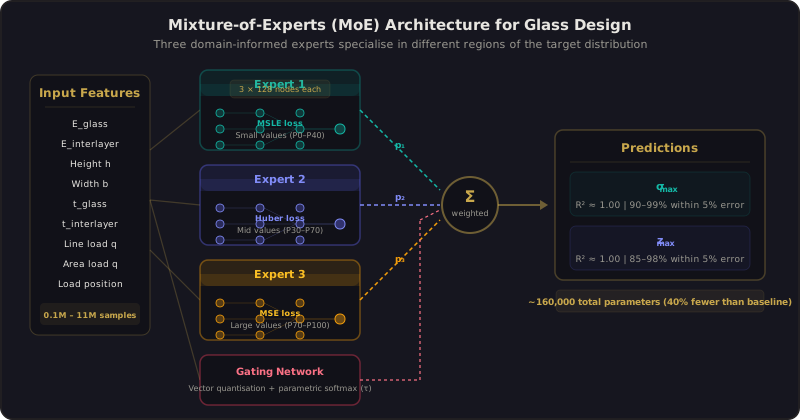
The custom MoE uses three specialised experts, each focusing on a different region of the target distribution:
| Expert | Loss function | Target range |
|---|---|---|
| Expert 1 | MSLE (Mean Squared Logarithmic Error) | Small values (0th–40th percentile) |
| Expert 2 | Huber loss | Intermediate values (30th–70th percentile) |
| Expert 3 | MSE (Mean Squared Error) | Large values / outliers (70th–100th percentile) |
Each expert uses 3 layers × 128 nodes with residual connections. A gating network (3 layers × 64 nodes) with vector quantisation and parametric softmax routes inputs to the appropriate expert. Total parameters: ~160,000 — 40% fewer than the baseline NN (~260,000).
MoE prediction: ŷ(x) = Σ pi · ei(x; θi), where pi is the gating weight from parametric softmax with trainable temperature τ.
Results: MoE vs. XGBoost vs. baseline NN
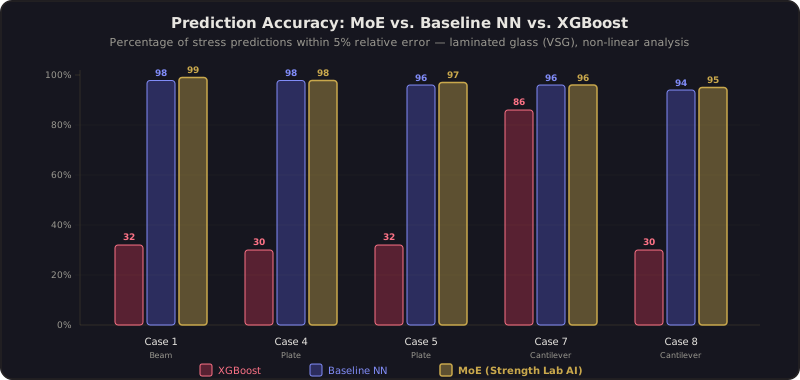
The MoE consistently outperforms both baselines across all cases. The improvement is most dramatic for laminated glass (VSG) under non-linear conditions:
| Metric | XGBoost | Baseline NN | MoE |
|---|---|---|---|
| % within 5% error (VSG, non-linear, stress) | 30–40% | 94–98% | 95–99% |
| R² (VSG, non-linear) | 0.59–0.94 | 1.00 | 1.00 |
| MAE stress, VSG non-linear (MPa) | 4.93–19.78 | 0.08–0.40 | 0.17–0.28 |
| Total parameters | N/A | ~260,000 | ~160,000 |
Key finding: This contradicts the established trend that XGBoost surpasses deep learning on tabular data. The heavy-tailed exponential distribution of the target variables (stresses and deflections) gave the domain-informed MoE a decisive advantage.
Independent verification was performed against Dlubal RFEM 5 and MEPLA, covering ~20 configurations per design case in both linear and non-linear settings.
Limitations
- Output limited to maximum stress and deflection — no distribution across the element.
- No load combination capability (real facades require multiple simultaneous load cases).
- Limited to 9 predefined design cases.
- No insulating glass unit (IGU) training data despite IGU prevalence in modern facades.
Early-Stage Thickness Prediction
An earlier, simpler approach by Griffith (Arup, GPD 2017) demonstrated that ML can be trained on modest datasets for early-stage design decisions. The specific task: predict minimum glass thickness for a four-side supported rectangular plate under uniform pressure.
A parametric pipeline (Grasshopper → Geometry Gym → Strand7 FEA via Python API) generated 1,080 FE models. Two ML approaches were compared:
| Approach | Architecture | Key result |
|---|---|---|
| Regression | 2-layer FNN (80 neurons, sigmoid + linear) | R ≈ 0.99; symmetric error distribution |
| Classification | Weighted k-NN / Ensemble Boosted Trees | 80–82% accuracy by glass type |
A practical rule of thumb emerged: “one order of magnitude of data for every input parameter” is likely to provide sufficient accuracy for early-stage design tools.
Hyperparameter investigation showed that 80 neurons provided the best generalisation balance — 8 neurons underfitted, 128 neurons overfitted. Error distributions were approximately normal and symmetric about the mean, meaning the model is equally likely to be conservative or unconservative — an important safety consideration for design tools.
AI for Manufacturing Quality Control
Pummel test classification
The Pummel test characterises adhesion between the polymeric interlayer and glass in laminated safety glass, using an optical scale from 0 (no adhesion) to 10 (very high adhesion). Currently assessed by human inspectors — subjective, non-repeatable, and statistically uncertain due to tester bias.
Test protocol: two float glass panes (max 2 × 4 mm), conditioned at −18°C for ~8 hours, then pummeled with a hammer on an inclined block. An inspector visually estimates the Pummel value from the exposed interlayer surface.
The AI Pummel Tool (M&M Network-Ing) replaces this with a pre-trained deep CNN operating on grey-value images, classifying into 11 categories. Image data augmentation compensates for limited labelled training data.
| Pummel class | CNN accuracy |
|---|---|
| 1, 3, 5, 7, 9 | >92% (classes 3 and 9 reach 100%) |
| 2, 4, 8 | 75–86% |
| 6 (worst) | 63% |
The confusion matrix suggests the 11-class scale could be lumped into 5–6 effective Pummel classes. More labelled data from manufacturers is expected to significantly improve performance.
Cut glass edge segmentation
Lateral cracks at cut glass edges correlate with edge strength but are slow and subjective to trace manually. A U-Net architecture (UXception variant) performs binary semantic segmentation (“breakage” vs. “undamaged glass”) on 192 × 192 pixel microscopy images.
Result: validation accuracy >99% for automated mask generation, with no human interaction required.
Edge strength from cutting parameters
An Extra Trees Regressor (Extremely Randomised Trees) predicts edge strength from 13 cutting process parameters (reduced from 25 by Boruta feature selection). Training R² = 1.000, test R² = 0.881. Edge strength range: ~40–120 MPa. The scatter suggests potential overfitting and the authors recommend investigating alternative algorithms.
Material Characterisation with Bayesian ML
Hyperelastic model calibration
Polymeric materials used in glass structures (structural silicones like DOWSIL TSSA and DOWSIL 993, interlayers PVB and EVA) require constitutive models capturing non-linear stress-strain behaviour. Kraus & Drass proposed a novel Helmholtz free energy functional in Nelder form:
Ψiso(I1, I2) = (I1 − 3) / (x1 + x2(I1 − 3)) + (I2 − 3) / (x3 + x4(I2 − 3))
Where I1, I2 are invariants of the left Cauchy-Green tensor, and θ = {x1, x2, x3, x4} are the four model parameters.
Calibration uses Bayesian supervised ML via the DREAM MCMC algorithm (Vrugt, 2016) on experimental data from uniaxial tension, uniaxial compression, biaxial tension, and shear pancake tests. Computation time: ~20 minutes on a standard laptop.
The Bayesian approach offers three key advantages over traditional least-squares optimisation:
- Uncertainty quantification: natural posterior distributions for all parameters.
- Safety factors: enables deduction of partial material safety factors at no extra cost.
- Model assessment: delivers reliability analysis quantities directly from the calibration.
Glass viscosity prediction
A neural network combined with the MYEGA viscosity equation (log η = A + (B/T) · exp(C/T)) achieves R² = 99.99% and RMSE = 0.04 for predicting glass melt viscosity — a grey-box model using a single hidden layer with 8 neurons and tanh activation, with hyperparameters tuned via Bayesian Optimisation (Tandia et al., 2019).
Glass Fracture Pattern Prediction
The BREAK algorithm (Kraus, 2019) combines linear elastic fracture mechanics (LEFM) with spatial statistical analysis to predict fragmentation patterns of thermally pre-stressed glass.
Fragment density depends on the elastic strain energy density UD, which is governed by the residual stress from thermal pre-stressing. The algorithm models the final fracture pattern as a Voronoi tessellation induced by a stochastic Strauss point process, with parameters calibrated from statistical analysis of fractured glass images.
A demonstrated example (t = 12 mm, σm = 31.54 MPa, U0 = 8.754 J/m³) produced simulated fracture patterns for a 1100 × 350 mm specimen that match the statistical properties of real fracture patterns.
Significance: “A combination of AI algorithms for regression and computer vision enable to model more complicated geometrical-numerical dependencies such as glass fracture patterns while carrying statistical features of its components, which was not possible by traditional approaches.” (Kraus & Drass, 2020)
ML as FEA Surrogates: Speedups and Limits
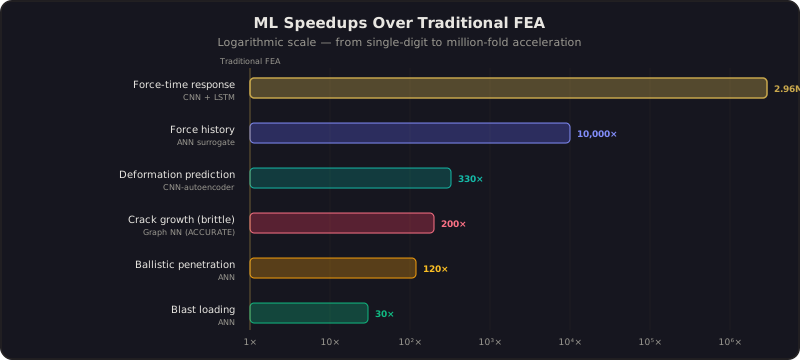
A comprehensive review by Nath et al. (2024), covering 241 references, documents ML/DL applications across all three FEA phases (preprocessing, solver, post-processing). The computational speedups achieved are substantial:
| Application | Method | Speedup vs. FEA |
|---|---|---|
| Force-time response (tube crushing) | CNN + LSTM | ~2,960,000× |
| Tubular structure force history | ANN | ~10,000× |
| Deformation prediction (tube crushing) | CNN-autoencoder + LSTM | ~330× |
| Crack growth in brittle materials | Graph NN (ACCURATE) | ~200× |
| Ballistic penetration depth | ANN | ~120× |
| Blast loading impulse | ANN | ~30× |
| Stress field mesh boosting | CNN (SMNet) | 2.83× |
| Aorta stress distribution | DL | <1 s vs. ~30 min |
Physics-Informed Neural Networks (PINNs)
PINNs encode governing PDEs directly into the loss function (LTotal = LPDE + LBC + LIC), enabling mesh-free solutions that handle both forward and inverse problems. Kraus et al. were among the first to apply PINNs to civil engineering (buckling resistance of steel hollow sections, 2020).
However, a controlled benchmark by Grossmann et al. (2023) testing PINNs on linear and non-linear PDEs in 1D, 2D, and 3D found that PINNs were unable to surpass FEM in solution time and accuracy. Their mesh-free nature and ability to handle inverse problems remain compelling advantages for specific use cases.
Techniques transferable to glass
Several techniques from adjacent domains are directly transferable to structural glass but not yet applied:
- ACCURATE framework (GNN for crack growth in brittle materials, ~200× faster than XFEM) — highly relevant to glass fracture.
- LSTM for viscoelastic materials — natural fit for PVB/SGP interlayer time-temperature dependent modelling.
- EUCLID framework — unsupervised discovery of constitutive laws from displacement data, applicable to novel interlayer chemistries.
- CNNs for stress field prediction (MAE 0.9% demonstrated for steel plates) — applicable to glass panels under complex loading.
Deployed Tools and Commercial Applications
| Tool | Developer | Application | Method |
|---|---|---|---|
| Strength Lab AI | M&M / Kuraray | Stress and deflection for monolithic & laminated glass | MoE deep learning |
| SOUNDLAB AI | M&M / Kuraray | Sound insulation (RW, STC, OITC) of glazing systems | Decision tree ML |
| AI Pummel Tool | M&M | Laminated glass adhesion quality control | Deep CNN |
| BREAK | Kraus (2019) | Tempered glass fracture pattern prediction | Strauss + Voronoi + LEFM |
All four tools originate from M&M Network-Ing UG (Kraus et al., Mainz, Germany), in some cases developed jointly with Kuraray Europe GmbH. Strength Lab AI and SOUNDLAB AI are available as web tools; the AI Pummel Tool is a commercial product; BREAK remains a research tool.
Knowledge Gaps and Future Directions
Despite rapid progress, significant gaps remain between current AI capabilities and the needs of structural glass practice:
| Domain | Gap | Priority |
|---|---|---|
| Structural design | No load combination capability in existing AI tools | High |
| Structural design | No IGU training data in Strength Lab AI despite IGU prevalence | High |
| Interlayer modelling | No deployed ML tool for laminated glass interlayer viscoelasticity | High |
| Verification | PINNs for structural glass remain conceptual; unable to beat FEM in benchmarks | High |
| Post-breakage | No ML approach for post-breakage structural capacity assessment | High |
| Fracture | BREAK limited to research tool; no commercial fracture prediction available | Medium |
| Facades | AI-supported adaptive facade control has no successful implementation yet | Medium |
| Data | Construction industry has lowest digitisation rate; data structuring is the primary bottleneck | High |
| Standards | No building code provides guidance on use of AI-based design tools for glass | High |
The main barrier is not technology but data: AI, software, and computing resources are already in place. The bottleneck is digitising and structuring existing industry data so that ML algorithms can be trained and validated (Kraus & Drass, 2020).
Explore FRACTAN’s Tools
From Prony series fitting to interlayer characterisation — use FRACTAN’s engineering tools for your structural glass projects.
Launch Dashboard