Eurocode 10: Design Strength, Laminated Glass, and Post-Breakage
This is Part 2 of 3. See also: Part 1: What It Is and Why It Matters • Part 3: IGU Design, Stability, and Worked Examples
Material Properties and Strengths
Annealed glass: characteristic bending strength fg,k
| Glass Type | Product Standard | fg,k (N/mm²) |
|---|---|---|
| Float glass | EN 572-2 | 45 |
| Polished wired glass | EN 572-3 | 33 |
| Drawn sheet glass | EN 572-4 | 45 |
| Patterned glass | EN 572-5 | 33 |
| Wired patterned glass | EN 572-6 | 27 |
Pre-stressed glass: characteristic bending strength fb,k
| Glass Type | TTG (EN 12150) | HSG (EN 1863) | Chem. Strengthened (EN 12337) |
|---|---|---|---|
| Float / drawn sheet | 120 | 70 | 150 |
| Patterned | 90 | 55 | 100 |
| Enamelled float / drawn | 75 | 45 | — |
| Enamelled patterned | 75 | 45 | — |
Partial safety factors
| Factor | CC1 | CC2 | CC3 |
|---|---|---|---|
| γM (basic material) | 1.6 | 1.8 | 2.0 |
| γP (surface pre-stress) | 1.1 | 1.2 | 1.3 |
Reliability basis
The partial safety factors are calibrated against the reliability classes defined in EN 1990. The target failure probabilities and corresponding reliability indices are:
| Consequence | Reliability Class | pf (1 year) | pf (50 years) | β (1 year) | β (50 years) |
|---|---|---|---|---|---|
| Small (CC1) | RC1 | 10−5 | 5 × 10⁻³ | 5.2 | 4.3 |
| Normal (CC2) | RC2 | 10−6 | 10−4 | 4.7 | 3.8 |
| Extraordinary (CC3) | RC3 | 10−7 | 10−5 | 4.2 | 3.3 |
The value γM = 1.8 for CC2 targets a 50-year reliability index β = 3.8, consistent with EN 1990. This has been confirmed by both FORM analysis assuming lognormal distributions and fully probabilistic approaches using Weibull statistics with random scratch orientation.
Design Bending Strength Formula
The total design bending strength consists of two components: intrinsic glass strength and pre-stress contribution:
fg,d = ke · ksp · λA · λl · kmod · (fg,k / γM) + kp · ke,p · (fb,k − fg,k) / (ki · γP)
| Factor | Meaning | Typical Values |
|---|---|---|
| kmod | Load duration factor | Permanent: 0.29 • Snow: 0.43 • Wind: 0.74 |
| ksp | Surface profile | As-produced float: 1.0 • Sandblasted: 0.6 |
| ke | Edge / hole finishing | As-cut: 0.8 • Seamed: 0.9 • Polished: 1.0 |
| kp | Pre-stressing process | Horizontal: 1.0 • Vertical: 0.60 |
| ki | Interference factor | Accounts for statistical interference between surface flaws and pre-stress (NDP) |
| λA | Area size effect | Relevant for panes > 18 m² |
| λl | Edge length effect | Relevant for edges > 6 m |
The first term captures the intrinsic strength of annealed glass, reduced by load duration, surface quality, and edge quality. The second term adds the beneficial contribution of pre-stress from thermal or chemical strengthening.
Laminated Glass: Three Modelling Levels
The interlayer shear coupling is the single most important factor for reducing glass mass and cost in laminated glass design. EN 19100 provides three levels of sophistication for modelling this coupling:
Level 1: Bounding Approach (No Shear / Full Shear)
The simplest approach: assume either no shear transfer (layered, conservative when shear is favourable) or full shear transfer (monolithic, conservative when shear is unfavourable, e.g. for load attraction in IGUs).
Warning: For statically indeterminate systems (IGUs, cold bent glass) or dynamic response assessment, Level 1 is not always conservative. A stiffer interlayer attracts more load, which can increase stresses in some configurations.
Level 2: Enhanced Effective Thickness (EET)
Based on the work of Galuppi & Royer-Carfagni (2012, 2014), the EET method calculates an equivalent monolithic thickness that produces the same deflection or stress as the actual laminate. It is an improvement over the older Wölfel/Bennison approach because it accounts for boundary conditions, load type, and multi-layered laminates.
The key parameter is the shear transfer coefficient η, which ranges from 0 (layered, no coupling) to 1 (monolithic, full coupling). It depends on the interlayer shear modulus Gint, which in turn depends on temperature and load duration.
This is where Prony series and time-temperature superposition become essential: the designer needs the interlayer shear modulus at the specific temperature and load duration of each design scenario.
Level 3: Numerical Models (FEM)
Level 3a: Linear elastic FE model with a constant shear modulus value for each load case (corresponding to the relevant temperature and load duration).
Level 3b: Transient viscoelastic FE model using Prony series and time-temperature superposition. This is the most accurate approach, but also the most computationally demanding.
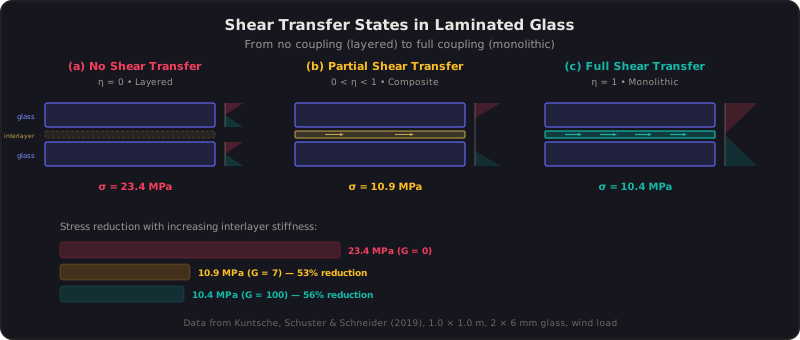
Why shear coupling matters: a practical example
For a 1.0 × 1.0 m two-side simply supported laminated glass panel (2 × 6 mm glass, 0.76 mm interlayer) under wind design load wd = 2.3 kN/m²:
| Interlayer | G (MPa) | Γ | σEd (MPa) | Stress Reduction |
|---|---|---|---|---|
| No shear bond | 0 | 0 | 23.4 | — |
| Standard PVB | 0.4 | 0.21 | 16.2 | −31% |
| Stiff PVB (Trosifol ES) | 7 | 0.82 | 10.9 | −53% |
| SentryGlas (ionoplast) | 100 | 0.98 | 10.4 | −56% |
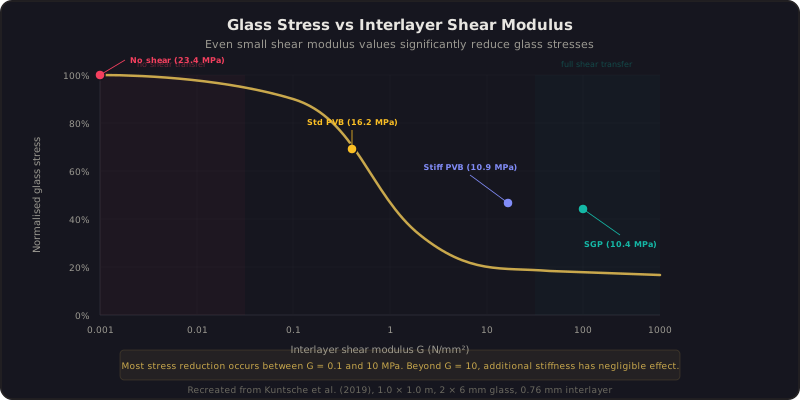
Even standard PVB with G = 0.4 MPa provides a 31% stress reduction compared to the no-shear assumption. Increasing from stiff PVB (7 MPa) to ionoplast (100 MPa) has almost no additional effect. This demonstrates that even modest interlayer stiffness delivers significant structural benefit, and that the conservative “no shear” approach used in DIN 18008 leaves substantial design efficiency on the table.
Enabling thinner glass
The impact of shear coupling on glass thickness selection is dramatic. For the same panel under the same loads, the “no shear bond” assumption requires 6 mm glass to pass the design check (σ = 23.4 MPa < Rd = 27.7 MPa per DIN 18008). With 4 mm glass and no shear coupling, the stress would be 52.7 MPa, nearly double the resistance.
However, with a stiff PVB interlayer (G = 7 MPa), the same 4 mm glass achieves σ = 22.8 MPa, passing the design check. This means the use of 4 mm glass becomes possible only when shear coupling is properly accounted for, which EN 19100 enables through its three-level approach. For large facades, this translates directly into significant material and cost savings.
Design resistance across different codes
The design resistance for the same glass (annealed float, seamed edges, short-term wind load) varies significantly across codes:
| Code | Rd (MPa) | Notes |
|---|---|---|
| DIN 18008 (Germany) | 27.7 | kmod=0.7, kc=1.8, γM=1.8 |
| prCEN/TS 19100 (Eurocode) | 20.8 | kmod=0.7, ke=0.7, RM=0.9, γM=1.8 |
| ASTM E1300 (USA) | 18.3 | From tabulated values for seamed annealed glass |
The German standard allows a higher design resistance due to the construction factor kc, which accounts for the positive effect of the construction type on post-breakage behaviour. In the Eurocode, the consequence class factor RM serves a similar but more conservative role.
German building approvals (abZ): interlayer shear modulus values
In Germany, since DIN 18008 does not allow favourable shear transfer in the base code, product manufacturers must obtain a general building authority approval (allgemeine bauaufsichtliche Zulassung, abZ) that specifies the shear modulus values permitted for design. These approvals provide either individual G values for specific load cases or full Prony series:
| Product | Approval No. | Prony Series | G Wind (MPa) | G Snow heated (MPa) | G Snow unheated (MPa) | G Dead (MPa) |
|---|---|---|---|---|---|---|
| Trosifol Extra Stiff (stiff PVB) | Z-70.3-236 | Yes | 7 | 0.58 | 100 | 0 |
| Saflex Structural / DG41 (stiff PVB) | Z-70.3-230 | Yes | 2 | 0.44 | 20.4 | 0 |
| EVASAFE (EVA) | Z-70.3-197 | No | 3.6 | 2.5 | 2.5 | 0 |
| SentryGlas SGP 5000 | Z-70.3-170 | No | 100 | 60 | 60 | 0 |
| Glaschobond SGP 5000 | Z-70.3-175 | No | 100 | 60 | 60 | 0 |
| GEWE Composite (cast resin) | Z-70.3-240 | Yes | 1.23 | 1.23 | 4.81 | 0 |
| Lamex X-Strong (std PVB) | Z-70.4-137 | No | 0.4 | 0 | 0 | 0 |
| SGT extra safe (std PVB) | Z-70.4-165 | No | 0.4 | 0 | 0 | 0 |
All products: G = 0 for dead load (permanent). This is because experimental methods (DMTA, creep tests) cannot reliably capture very long-term effects such as chemical creep, phase changes, or ageing that occur over decades. Under EN 19100, this limitation applies equally: interlayer stiffness under permanent loads should be treated with extreme caution.
Shear Coupling Across National Codes
One of the most significant differences between national glass design standards is how they handle interlayer shear coupling. The following table, based on Kuntsche et al. (2019), summarises the approaches:
| Standard | Design Concept | Shear Modulus Approach |
|---|---|---|
| Germany DIN 18008 | No favourable shear transfer; only “no shear” and “full shear” limit states | None (only via abZ approvals) |
| Austria ÖNORM B 3716 | Partial shear bond possible; no specific method | One G value for PVB (0.4 MPa for wind) |
| Belgium NBN S 23-002 | Effective thickness method, similar to prEN 16612 | One ω value, one load case, PVB only |
| France NF DTU 39 P4 | Reduction of equivalent required thickness | None |
| Italy CNR-DT 210 | Three levels: (a) EET, (b) FEM constant G, (c) FEM viscoelastic | G values from manufacturers or testing |
| Netherlands NEN 2608 | Partial shear bond, effective thickness method | Prony series + WLF for PVB and ionoplast |
| Norway NS 3510 | Partial shear bond possible | Tabulated G for different load cases |
| USA ASTM E1300 | Non-factored load charts + effective thickness | One G value, formula for ω (A = 9.6 always) |
| Europe prEN 16612 | Effective thickness via stiffness families | Stiffness families 0, 1, 2 (ω tabulated) |
| Eurocode prCEN/TS 19100 | Levels 1–3b: bounds, EET, FEM constant, FEM viscoelastic | G from EN/ETA or experimental testing |
Germany is the most conservative: the base code prohibits favourable shear transfer entirely. At the other end, the Netherlands (NEN 2608) already includes Prony series and WLF constants for two interlayer types directly in the standard. The Italian CNR-DT 210 and the Eurocode share the most sophisticated approach with three modelling levels. EN 19100 will harmonise these disparate approaches into a single European framework.
Post-Breakage Behaviour
The FLS and PFLS are what make EN 19100 fundamentally different from other Eurocodes. Three resistance mechanisms are distinguished for laminated glass after breakage:
Mechanism I: All glass plies are sound. The interlayer provides shear coupling and composite plate theory applies. This phase ends when the first ply breaks.
Mechanism II: One ply is broken, the remaining ply or plies carry the full load. The interlayer retains the broken shards, and if the distance between cracks is large enough, the polymer still transfers shear between intact zones. This mechanism works better with annealed or heat-strengthened glass (large shards) than with toughened glass (small fragments).
Mechanism III: All plies are broken. Glass fragments carry compression by contact, while the polymer interlayer provides the tensile force (acting as a membrane). The load-bearing capacity depends heavily on fragment size:
- Annealed glass: Large shards → good post-breakage capacity
- Heat strengthened glass: Medium shards → good post-breakage capacity
- Toughened glass: Tiny fragments → “wet towel” effect → poor post-breakage unless a very stiff interlayer (ionoplast) is used
Practical implication: For overhead glazing, barriers, and glass floors, the choice of glass type and interlayer directly determines post-breakage safety. Float or heat-strengthened glass with PVB or ionoplast often provides better residual capacity than fully toughened glass.
References
- Feldmann, M. et al. (2023). “The new CEN/TS 19100: Design of glass structures.” Glass Structures & Engineering, 8:317–337. doi:10.1007/s40940-023-00219-y (Open Access)
- Feldmann, M., Kasper, R. & Laurs, M. (2025). “EN 19100 Design of Glass Structures: Key changes and benefits through design examples.” JRC Workshop “The Second Generation Eurocodes”, 5 June 2025.
- Feldmann, M., Kasper, R. et al. (2014). “Guidance for European Structural Design of Glass Components.” JRC EUR 26439 EN. Free PDF from EU Publications Office
- Kuntsche, J., Schuster, M. & Schneider, J. (2019). “Engineering design of laminated safety glass considering the shear coupling: a review.” Glass Structures & Engineering, 4:209–228. doi:10.1007/s40940-019-00097-3
- Siebert, G. (2025). “Benefits of revised German code for glass design.” Glass Structures & Engineering, 10:5. doi:10.1007/s40940-024-00286-9 (Open Access)
- Galuppi, L. & Royer-Carfagni, G. (2014). “Enhanced effective thickness of multi-layered laminated glass.” Composites Part B, 64:202–213. doi:10.1016/j.compositesb.2014.04.018
- Galuppi, L. et al. (2020). “BAM approach for IGU cavity pressure calculation.” Based on Betti’s Analytical Method using Green’s functions.
- CEN/TS 19100-1:2021 — Design of glass structures — Part 1: Basis of design and materials.
- CEN/TS 19100-2:2021 — Design of glass structures — Part 2: Out-of-plane loaded glass components.
- CEN/TS 19100-3:2021 — Design of glass structures — Part 3: In-plane loaded glass components.
Get Interlayer Data for EN 19100 Design
EN 19100 Level 2 and Level 3 design requires the interlayer shear modulus at specific temperatures and load durations. Use our free Prony series calculator to extract G(t, T) for any interlayer material from DMTA data or our built-in database.
Launch Prony Calculator