Eurocode 10: IGU Design, Stability, Detailing, and Worked Examples
This is Part 3 of 3. See also: Part 1: What It Is and Why It Matters • Part 2: Design Strength and Laminated Glass
Insulating Glass Unit Design
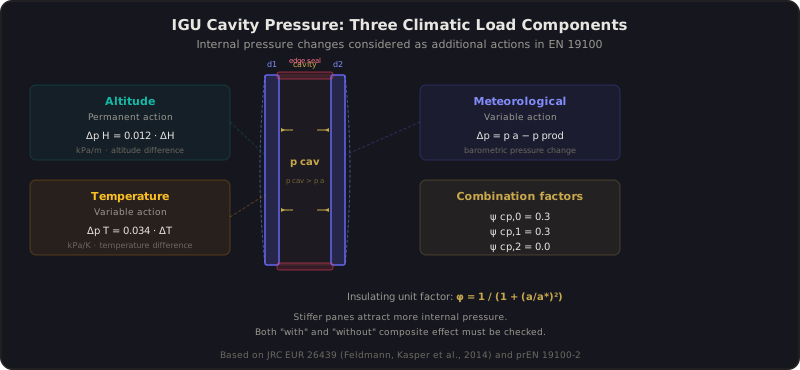
IGUs experience internal cavity pressure changes from three sources, treated as additional actions in EN 19100:
- Altitude difference (permanent action): ΔpH = 0.012 kPa/m · (H − Hproduction)
- Temperature difference (variable action): ΔpT = 0.034 kPa/K · (T − Tproduction)
- Meteorological pressure change (variable action): Δpp = pa − pproduction
Combination factors for cavity pressure: ψcp,0 = 0.3, ψcp,1 = 0.3, ψcp,2 = 0.0.
BAM-Approach (new in EN 19100)
The BAM-Approach (Betti’s Analytical Method), developed by Galuppi et al. (2020), uses Green’s functions for accurate load sharing between IGU panes. It is introduced as Annex C of prEN 19100-2 and provides a more rigorous alternative to the traditional simplified method. The EN version extends the formulas from double to triple IGUs as well.
IGU load sharing: simplified method
For rectangular double IGUs under distributed loading, the load distribution between panes is governed by the insulating unit factor φ:
φ = 1 / (1 + (a / a*)2)
Where a = length of the short edge, and a* = 28.9 · 4√(da3 · di3 · dcav / ((da3 + di3) · BV)) is the characteristic length of the unit.
The stiffness partition for each pane is δ1 = d13 / (d13 + d23) and δ2 = d23 / (d13 + d23). The effective loading on each pane combines external loads, stiffness partition, and internal climatic pressure through the insulating unit factor. For IGUs with laminated glass panes, both “with composite effect” and “without composite effect” cases must be considered, because the stiffer the glass plate, the higher the internal pressure it attracts.
Recommended climatic values (NDPs)
| Parameter | EN 19100 Recommended |
|---|---|
| Altitude change ΔH | +600 m |
| Meteorological pressure Δpmet | 2 kPa |
| Temperature difference ΔT | +20 K |
In-Plane Loading and Stability
Part 3 of EN 19100 covers glass elements loaded primarily in-plane: beams, fins, columns, and shear panels. These require stability analysis because glass elements are typically slender.
Imperfection values for stability design
| Buckling Type | e0,length | e0,installation |
|---|---|---|
| Flexural + plate buckling | l0 / 333 | hs / 2 |
| Lateral torsional buckling | l0 / 450 | hs / 2 |
| Shear buckling | l0 / 1000 | hs / 5 |
Second-order analysis is required when the elastic critical load ratio αcr = Mcr / MEd < 10. Effective stiffness formulas (EIz,eff and GIT,eff) account for interlayer shear coupling in the stability analysis of laminated glass beams.
Deflection Limits
EN 19100 introduces three deformation classes, depending on what the deflection affects:
| Class | Load Combination | Purpose | Example |
|---|---|---|---|
| 1-SLS | Frequent | Aesthetical | Canopy drainage, IGU pillowing |
| 2-SLS | Characteristic | Integrity / functionality | Ponding, airtightness, edge seal damage |
| 3-ULS | Fundamental | Safety | Glass floor slipping from supports |
Recommended deflection limits (Class 2-SLS)
| Element | Support Condition | Limit |
|---|---|---|
| Glass component, all edges | Continuously supported | Centre: L/50 |
| Glass component, 2–3 edges | Continuously supported | Free edge: L/100 |
| Point-fixed glass | — | Centre: L/50, Free edge: L/100 |
| Glass floor, all edges | Continuously supported | Centre: L/200 |
| IGU, all edges | Continuously supported | Centre: L/50 |
| IGU, point-fixed | — | Centre: L/150 |
| Balustrade | Clamped at bottom | Gap max 50 mm between elements at 1 m height |
Construction Rules and Detailing
The JRC guidance document and CEN/TS 19100 establish fundamental construction rules that apply to all glass structures, regardless of the design level:
- Glass-steel contact and glass-glass contact must be avoided. Hard contact creates stress concentrations that can initiate fracture. All contact surfaces must use intermediate layers (mortar, polymeric pads, neoprene).
- Glass panels must be fixed without excessive constraint. Over-constraining glass creates locked-in stresses that reduce the effective design resistance and can cause spontaneous breakage under thermal loads.
- Support materials must be durable for the expected service life. Degradation of gaskets, sealants, or setting blocks can lead to glass-to-metal contact over time.
- Humidity drying near laminated glass edges must be enabled. Trapped moisture at the interlayer edge accelerates delamination and reduces long-term bond strength.
- Thermal stresses must be considered where relevant heat absorption is present: partial shading, coatings, spandrel panels, proximity to heating devices. In some countries (France, Belgium) thermal stress is a formal load case; in Germany it is managed by specifying toughened glass where thermal risk exists.
Balustrades and Barrier Glazing
Barrier glazing is one of the most common applications where all four limit states (LSS-3) come into play. The revised DIN 18008-4 (2023) provides a useful reference for how barrier glazing is classified, and EN 19100 Part 2 formalises this through the FLS/PFLS framework.
Category classification (per DIN 18008-4)
Category A: The glass element solely carries the barrier loads.
- A1: Glass clamped at the bottom edge (cantilevering)
- A2: Glass fixed with point fixings or combinations of linear and point support (new in revision)
- A3: Glass spanning between supports (e.g., between posts)
Category B: Individual glass elements are connected by a continuous handrail. If one glass panel fails, the handrail redistributes the barrier load to adjacent panels. The revision removes the previous restriction to bottom-clamped cantilevering only; all combinations of linear and point support are now permitted.
Category C: Infill glazing only. The glass does not carry the barrier load; it merely fills the space between structural elements.
Breakage scenarios for barriers
The breakage scenario depends on edge protection:
- With sufficient edge protection: Only the inner glass ply (facing the traffic side) is assumed broken.
- Without edge protection: Both outer layers are assumed broken and are excluded from the calculation entirely.
Under EN 19100, these scenarios are formalised as FLS (impact during fracture) and PFLS (residual capacity after fracture) verifications, with reduced loading applied for the post-fracture check. The LSS assignment determines exactly which checks are required for each category and consequence class.
Worked Design Examples
The following examples are from the 2025 JRC Workshop presentation by Feldmann, Kasper, and Laurs:
Example 1: Insulating Glass Unit (CC1, LSS-0)
- Geometry: 1000 × 1250 mm, annealed float 8 | 16 | 8 mm
- Loading: Wind + climatic loads (BAM-Approach for cavity pressure)
- ULS check: σEd = 11.24 MPa < fg,d = 16.31 MPa → PASS
- SLS check: w = 3.14 mm < L/50 = 20 mm → PASS
Example 2: Glass Parapet (CC2, LSS-3)
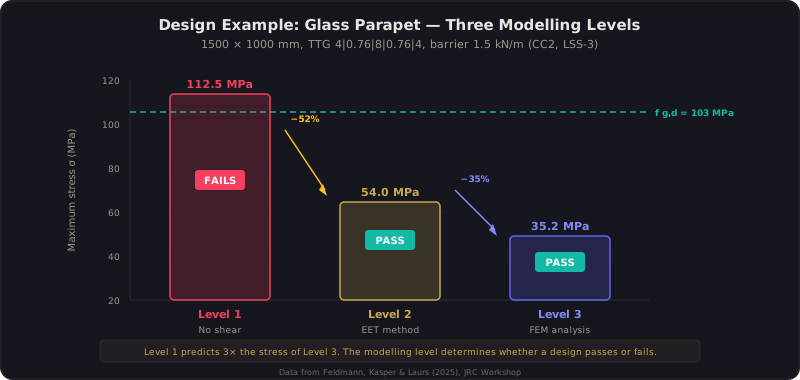
- Geometry: 1500 × 1000 mm, TTG laminated 4 | 0.76 | 8 | 0.76 | 4 mm
- Loading: Barrier load hk = 1.5 kN/m
- Three modelling levels compared:
- Level 1 (no shear): σ = 112.5 MPa
- Level 2 (EET): σ = 53.96 MPa
- Level 3 (FEM): σ = 35.16 MPa
- ULS check: 80.94 < 103 MPa → PASS
- SLS check: 64 > 50 mm → FAILS (needs stiffer interlayer)
- PFLS check: With one pane fractured: 56.25 < 103 MPa → PASS
This example shows the dramatic difference between modelling levels: Level 1 predicts more than three times the stress of Level 3. It also demonstrates that SLS (deflection) can be the governing criterion even when ULS passes comfortably.
Example 3: Glass Fin (CC2, LSS-3)
- Geometry: 300 × 3000 mm, HSG 10 | 1.52 | 10 mm, fork bearings
- Loading: Wind wk = 1.5 kN/m²
- Issue: Lateral torsional buckling is relevant (αcr = 1.76 < 10)
- Method: FE analysis with imperfections (e0 = 12.66 mm)
- Result: σ = 28.49 MPa < fg,d = 40.83 MPa → PASS
- PFLS: Accounts for broken ply expansion affecting residual stiffness
References
- Feldmann, M. et al. (2023). “The new CEN/TS 19100: Design of glass structures.” Glass Structures & Engineering, 8:317–337. doi:10.1007/s40940-023-00219-y (Open Access)
- Feldmann, M., Kasper, R. & Laurs, M. (2025). “EN 19100 Design of Glass Structures: Key changes and benefits through design examples.” JRC Workshop “The Second Generation Eurocodes”, 5 June 2025.
- Feldmann, M., Kasper, R. et al. (2014). “Guidance for European Structural Design of Glass Components.” JRC EUR 26439 EN. Free PDF from EU Publications Office
- Kuntsche, J., Schuster, M. & Schneider, J. (2019). “Engineering design of laminated safety glass considering the shear coupling: a review.” Glass Structures & Engineering, 4:209–228. doi:10.1007/s40940-019-00097-3
- Siebert, G. (2025). “Benefits of revised German code for glass design.” Glass Structures & Engineering, 10:5. doi:10.1007/s40940-024-00286-9 (Open Access)
- Galuppi, L. & Royer-Carfagni, G. (2014). “Enhanced effective thickness of multi-layered laminated glass.” Composites Part B, 64:202–213. doi:10.1016/j.compositesb.2014.04.018
- Galuppi, L. et al. (2020). “BAM approach for IGU cavity pressure calculation.” Based on Betti’s Analytical Method using Green’s functions.
- CEN/TS 19100-1:2021 — Design of glass structures — Part 1: Basis of design and materials.
- CEN/TS 19100-2:2021 — Design of glass structures — Part 2: Out-of-plane loaded glass components.
- CEN/TS 19100-3:2021 — Design of glass structures — Part 3: In-plane loaded glass components.
Get Interlayer Data for EN 19100 Design
EN 19100 Level 2 and Level 3 design requires the interlayer shear modulus at specific temperatures and load durations. Use our free Prony series calculator to extract G(t, T) for any interlayer material from DMTA data or our built-in database.
Launch Prony Calculator