Eurocode 10 (EN 19100): What It Is and Why It Matters
This is Part 1 of 3. Continue reading: Part 2: Design Strength and Laminated Glass • Part 3: IGU Design, Stability, and Worked Examples
Why Eurocode 10?
Before EN 19100, structural glass design in Europe was governed by over 20 different national standards. Germany used DIN 18008, Italy relied on CNR-DT 210 and UNI 7697, the Netherlands had NEN 2608, France used NF DTU 39, and the UK followed BS 6180 and BS 6262. Many of these standards were contradictory, incomplete, or incompatible with EN 1990, the Eurocode basis of structural design.
This fragmented landscape meant that designs for anything beyond basic window glazing often required special approvals. Safety levels varied from country to country. There were no codified rules at all for primary structural glass elements (beams, columns, shear panels) in most jurisdictions. The situation hindered free trade in engineering services and made cross-border projects unnecessarily complex.
EN 19100, designated Eurocode 10, solves this by providing a single, unified set of design rules for structural glass across all CEN member states. It is the first-ever European structural design code for glass.
Key national codes being replaced by EN 19100:
Germany: DIN 18008 • Italy: UNI 7697, UNI 11463, CNR-DT 210 • UK: BS 6180, BS 6262 • France: FD DTU 39 P5 • Netherlands: NEN 2608, NEN 3569 • Austria: ÖNORM B 3716 • Belgium: NBN S23-002 • Switzerland: SIA 358 • Spain: CTE DA DB-SUA/1 • Norway: NS 3510 • Czech Republic: CSN 74 3305 • Portugal: LNEC ITE 9 • Denmark: DS410 • Croatia: NN 53/2017
Timeline and Status
The development of EN 19100 has been a multi-phase process driven by the European Commission mandate M/515 to CEN/TC 250:
| Year | Milestone |
|---|---|
| 2007 | JRC initiative: justification for new glass design standards |
| 2012 | EC Mandate M/515: extending Eurocodes to include glass |
| 2014 | JRC EUR 26439: pre-normative guidance document (Task I) |
| 2016 | CEN/TC 250 Working Group 3 elevated to Subcommittee SC 11 |
| 2021 | CEN/TS 19100 Parts 1–3 published (for use parallel to national standards) |
| 2024 | CEN Enquiry of prEN 19100 begins (Task III) |
| 2026 | Formal Vote + Publication of EN 19100 |
| 2027 | National Application Documents (NADs) prepared |
| Mar 2028 | Withdrawal of ALL conflicting national standards |
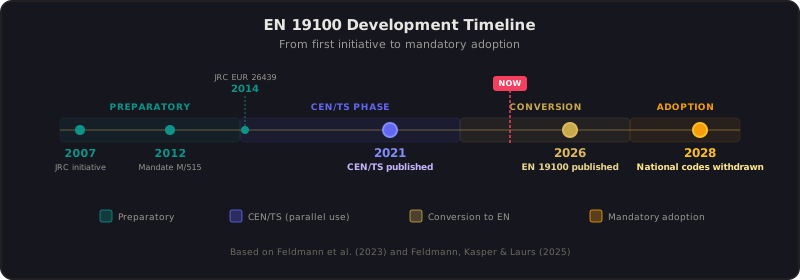
Practitioners should start familiarising now. EN 19100 publication is expected in 2026, with mandatory use by March 2028. The standard is developed under CEN/TC 250 / SC 11, chaired by Prof. Dr.-Ing. Markus Feldmann (RWTH Aachen).
Relationship with EN 16612
EN 19100 (CEN/TC 250, SC 11) is a design standard within the Eurocode family, applicable to glass components in Consequence Classes 1, 2, and 3. EN 16612 (CEN/TC 129, WG8) is a product standard for calculating lateral load resistance, applicable to lower-consequence components. The classification of which components fall under which standard is a national prerogative through the National Annex.
Structure of EN 19100
The standard consists of four parts, three of which will become full European Norms (EN):
Part 1: General Rules (prEN 19100-1)
Covers the basis of design, materials, structural analysis methods, and structural provisions. Contains the core design equations and partial safety factors. Annexes address design bending strength calculation, in-plane thermally induced stress, and temperature risk assessment.
Part 2: Out-of-Plane Loaded Glass Components (prEN 19100-2)
Covers laterally loaded elements: IGUs, laminated glass panels, barriers, floors, canopies. Includes verification of FLS and PFLS, deflection limits, and rules for edge-supported, point-supported, and cantilevered glass. Annexes cover the Enhanced Effective Thickness (EET) method, natural frequency verification, IGU cavity pressure (BAM-Approach), and cold bent glass.
Part 3: In-Plane Loaded Glass Components (prEN 19100-3)
Covers glass elements primarily subjected to in-plane loads: beams, fins, columns, shear panels. Includes stability design, imperfection rules, and mechanical joint design (bolted, friction, spliced). Annexes provide critical buckling loads, effective stiffness formulas for laminated glass, and simplified Km-values.
Part 4: Glass Selection (CEN/TS 19100-4)
Deals with the risk of human injury from glazing: collision, falling through, falling fragments. This part remains a CEN/TS and will NOT convert to a full Eurocode, because glass selection for safety in use depends on national building legislation (CPR basic requirement 4) rather than structural design (requirement 1).
Design Philosophy: Robustness
Glass is a perfect brittle material with zero ductility. Unlike steel or concrete, there is no yielding, no plastic redistribution, and no warning before failure. Breakage of a glass ply must always be expected: the cause can be impact, thermal stress, nickel sulphide inclusions, surface damage, or any combination. The standard describes this as “failure of unknown origin.”
Consequently, glass design under EN 19100 is fundamentally robustness design, built on two pillars:
Cross-sectional robustness: The number and thickness of glass plies, the type of glass (annealed, heat strengthened, toughened), the type of interlayer (standard PVB, stiff PVB, ionoplast), and the edge protection and detailing.
Structural robustness: The detailing of connections, the type and capacity of a second load path, protection and hold-back measures, and the redundancy of the overall structure.
Four Limit States (SLS, ULS, FLS, PFLS)
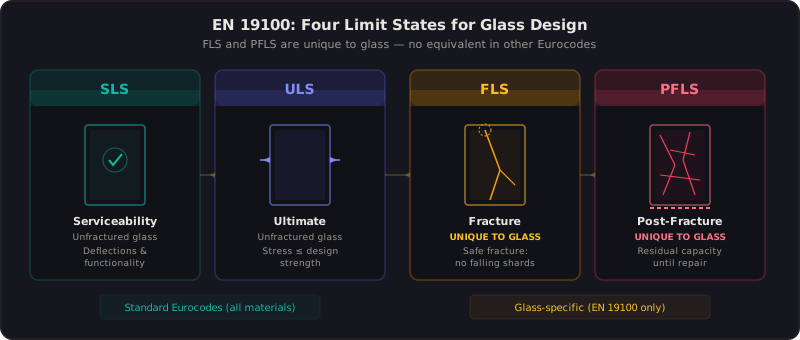
EN 19100 introduces two limit states unique to glass that have no equivalent in any other Eurocode:
| Limit State | Glass Condition | What Is Verified |
|---|---|---|
| SLS | Unfractured | Deflections, aesthetics, functionality |
| ULS | Unfractured | Stress ≤ design strength |
| FLS (Fracture Limit State) | During fracture | Safe fracture: no shards falling, no severe injury from splinters, residual capacity for a limited time |
| PFLS (Post-Fracture Limit State) | After fracture | Residual load capacity under reduced loading until repair is possible |
Limit State Scenarios (LSS)
The standard bundles limit states into four verification packages called Limit State Scenarios:
| Scenario | SLS | ULS | FLS | PFLS | Typical Application |
|---|---|---|---|---|---|
| LSS-0 | ✓ | ✓ | — | — | Basic window IGU |
| LSS-1 | ✓ | ✓ | ✓ | — | Glazing with fracture requirements |
| LSS-2 | ✓ | ✓ | — | ✓ | Glazing with post-fracture requirements |
| LSS-3 | ✓ | ✓ | ✓ | ✓ | Barriers, overhead glazing, structural glass |
Critical NDP: The assignment of Limit State Scenarios to component types is a Nationally Determined Parameter. Each country defines through its National Annex which components must be verified under which LSS. This is the most consequential NDP in EN 19100.
Comparison with National Codes
EN 19100 vs DIN 18008 (Germany)
| Parameter | EN 19100 | DIN 18008 |
|---|---|---|
| γM (annealed) | 1.6 / 1.8 / 2.0 (by CC) | 1.8 (fixed) |
| kmod (wind) | 0.74 | 0.7 |
| kmod (snow) | 0.43 | 0.4 |
| kmod (permanent) | 0.29 | 0.25 |
| Edge stress | ke factor (as-cut = 0.8, seamed = 0.9) | 80% of surface strength (fixed) |
| Shear coupling | Three levels allowed in the code | Not allowed (only via special approvals “abZ”) |
| Post-breakage | Formal FLS + PFLS limit states | Per application part, no unified framework |
The most significant difference is that DIN 18008 does not allow favourable shear transfer in the base code. Only “no shear” and “full shear” bound states are considered. To use interlayer stiffness in design, engineers need a product-specific general building authority approval (abZ). EN 19100 removes this barrier by providing three modelling levels directly in the code.
DIN 18008 consists of six parts: Part 1 (terms and general basis), Part 2 (linearly supported glazing), Part 3 (point-fixed glazing), Part 4 (barrier glazing), Part 5 (walk-on glazing), and Part 6 (fall-through glazing and maintenance). The design resistance follows Rd = kmod · kc · fk / γM, where the construction factor kc is unique to DIN 18008 and has no direct equivalent in EN 19100. After EN 19100 implementation, DIN 18008 will continue as a national complement specifying construction details and application-specific requirements.
Key innovations in revised DIN 18008 (2020–2023)
The revision introduces several features of interest to practitioners:
- Reduced safety for small IGUs: IGUs up to 2 m² can use γF = 1.0 for climatic loads, accepting a higher breakage probability given the low consequences. This allows many configurations with annealed glass where tempered glass was previously required, reducing embedded energy and carbon.
- Conical bore holes: New rules for countersunk (flush) point fixings, with minimum countersink depth s ≥ 4 mm and ratio s/t between 0.2 and 0.8.
- Reduced minimum edge distances: From 80 mm down to 50 mm near toughened glass holes, based on recent research on prestress anisotropy.
- Thin glass (2 mm): New partial safety factors γM = 1.9 for annealed and 1.6 for tempered 2 mm glass.
EN 19100 vs CNR-DT 210 (Italy)
| Parameter | EN 19100 | CNR-DT 210 |
|---|---|---|
| γM | 1.6–2.0 | 2.55 |
| γM,v (pre-stress) | 1.1–1.3 | 1.35 |
| Shear coupling | Levels 1–3 | Levels a–c (similar approach) |
| kmod | Tabulated values | kmod = 0.585 · t−1/16 (continuous formula) |
The Italian CNR-DT 210 guideline already adopted a multi-level approach to shear coupling similar to EN 19100, including the Enhanced Effective Thickness method developed at the University of Parma. EN 19100 aligns well with the Italian approach, though with different partial safety factors.
What Changes from CEN/TS to EN
The conversion from CEN/TS 19100 to the full EN 19100 introduces several improvements:
- Parts 1–3 become binding European Norms (Part 4 remains CEN/TS)
- Full alignment with EN 1990:2023 and all other 2nd generation Eurocodes
- BAM-Approach for IGU cavity pressure (new Annex C in Part 2)
- Enhanced Effective Thickness (EET) method in Annex A of Part 2
- Triple IGU load distribution formulas (extended from double IGUs only)
- Effective cross-section formulas for laminated glass stability (EIz,eff, GIT,eff)
- Imperfection rules for in-plane loaded glass components
- PFLS load combinations aligned with EN 1990:2023
- Cold bent glass provisions (new Annex D in Part 2)
- Updated references to EN 1991-1-1:2025 for barrier loads
References
- Feldmann, M. et al. (2023). “The new CEN/TS 19100: Design of glass structures.” Glass Structures & Engineering, 8:317–337. doi:10.1007/s40940-023-00219-y (Open Access)
- Feldmann, M., Kasper, R. & Laurs, M. (2025). “EN 19100 Design of Glass Structures: Key changes and benefits through design examples.” JRC Workshop “The Second Generation Eurocodes”, 5 June 2025.
- Feldmann, M., Kasper, R. et al. (2014). “Guidance for European Structural Design of Glass Components.” JRC EUR 26439 EN. Free PDF from EU Publications Office
- Kuntsche, J., Schuster, M. & Schneider, J. (2019). “Engineering design of laminated safety glass considering the shear coupling: a review.” Glass Structures & Engineering, 4:209–228. doi:10.1007/s40940-019-00097-3
- Siebert, G. (2025). “Benefits of revised German code for glass design.” Glass Structures & Engineering, 10:5. doi:10.1007/s40940-024-00286-9 (Open Access)
- Galuppi, L. & Royer-Carfagni, G. (2014). “Enhanced effective thickness of multi-layered laminated glass.” Composites Part B, 64:202–213. doi:10.1016/j.compositesb.2014.04.018
- Galuppi, L. et al. (2020). “BAM approach for IGU cavity pressure calculation.” Based on Betti’s Analytical Method using Green’s functions.
- CEN/TS 19100-1:2021 — Design of glass structures — Part 1: Basis of design and materials.
- CEN/TS 19100-2:2021 — Design of glass structures — Part 2: Out-of-plane loaded glass components.
- CEN/TS 19100-3:2021 — Design of glass structures — Part 3: In-plane loaded glass components.
Get Interlayer Data for EN 19100 Design
EN 19100 Level 2 and Level 3 design requires the interlayer shear modulus at specific temperatures and load durations. Use our free Prony series calculator to extract G(t, T) for any interlayer material from DMTA data or our built-in database.
Launch Prony Calculator